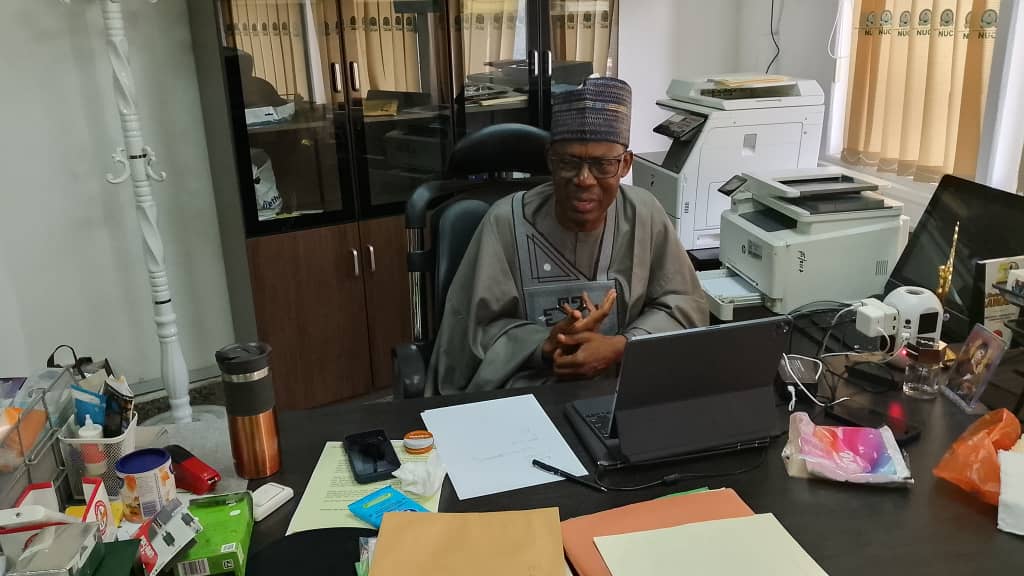
Former Executive Secretary of NUC, Chris Maiyaki
Chris Maiyaki is the former Acting Executive Secretary of the National Universities Commission (NUC), Nigeria’s apex regulatory body for university education. Appointed on June 30, 2023, following the voluntary resignation of Prof. Abubakar Adamu Rasheed, Maiyaki brought to the role over three decades of experience in public service and deep institutional knowledge of the NUC, where he previously served as Deputy Executive Secretary (Administration) and Director of the Executive Secretary’s Office.
As he approaches retirement, Maiyaki sat down with select media organizations in Abuja (including NATIONAL ACCORD) to reflect on the state of Nigeria’s university system, persistent industrial actions by university unions, challenges in the higher education regulatory environment, and his personal journey in public service.
*Q: You have seen it all in the university system, having spent 35 years of service. What do you think needs to be done to have a better university system?*
*Response*: We have to dream, to aspire, to advocate, to negotiate a better university system presupposes that we’ll place a premium on the pivotal role of universities.
That takes me to the inevitability of the pivotal role of universities. Universities bring development. Universities you know, create a generation of highly skilled, highly educated people. There’s hardly any country that can outgrow the level of investment it makes in its educational system. Namkuti, refinery. Who do you think will be driving those places? Who are the people, invisible hands that will drive the operation, the sustenance and the success of the enterprise? Even politics. Even the Senate. Go and see, they have to hire consultants to analyze those bills for them. You know that. They’re academics, people who work behind the scenes. Okay? Technology. Who’s driving technology? How do we have speed, what do you call it, high‑speed aircraft now? This is research. If you have flown, I know you have flown airplanes. You see those slim, slim aircraft. That’s the product of the University of McGill in Montreal in Canada. The Insulin. You know the Insulin? University of Toronto.
Blackberry is an invention of Waterloo. There’s hardly anything about modern human invention that you cannot attribute to research, learning. Do you understand? And the work of universities and academics over there. What I’ve done is to raise, make a case for the role that universities can play in our lives. Yes. I have to converse the sentiments first.
Our universe is important. Do we place a premium on education of the university? Education is at the heart of our opportunities. My brother, whether as a family, whether whether as a senator, whether as a community, our life choices would gravitate.
The choice of your friends is a function of your educational exposure. The risk that you take or you don’t take is a function of your education. Even how, what to wear, even what to eat, where to go to.
The joints you decide to go to after this interview is a function of the friends that you keep, the choice of medicine. So have we agreed that education is important? If not for education, what are we doing here? We would have been fishermen. This guy would have been stopping those trucks on the Benin Asaba Highway. Okay? Education is at the heart of our opportunities.
Let me tell you, the pivotal role, let me tell you, the politician of our era that plays a premium on education that I always quote, Theresa May. Theresa May. You remember her? Former Prime Minister of the UK. When the UK was exiting Europe, you remember the Brexit? They were getting out of the common market. Theresa May faced a lot of stiff opposition. Resistance from the British. They were ideologically divided. They still are. They regret leaving the European Union. But it was at that defining moment that she resorted to the nation. She addressed the nation. She said, even if they were going to lose everything as a country, they would fall back on their university system to reinvent the United Kingdom. So do we agree that universities have a role to play? Without university, all the people in the Senate, who makes us different from the people in the village? It’s because we went to school. There’s a value addition to our lives. Do you understand? That’s why today we can load it on people. I’m telling you. You think we’re special people? No, we’re just lucky. We’re privileged people to have gone to school. That’s the role of education. Imagine Samaru in Zaira without ABU. Imagine Akoka without UNILAG. Imagine Nsuka without the University of Nigeria. Imagine Abraka without Delta State University. Universities bring about development. Universities bring about the economies of large scale. People supplying water, hostels, markets, everything. It can happen. So, we have made a case that universities play a major role in the lives of our community, in the lives of our nation, in the lives of our family. What do we need to do? We need to be very deliberate, very intentional about investing in education. We need to be very deliberate. We cannot treat education with kids’ gloves, with levity, you know, as an afterthought.
We cannot afford to. I just told you how I was privileged to visit the King Abdulaziz University in Jeddah, where in a postgraduate university, they had over 2,000 laboratories for only 1,500 students. They endowed 10 billion. The late king of Saudi Arabia endowed 10 billion. That university was founded 10 years ago. And they invested the 10 billion, you know, in trust, in investments overseas, and they’re living on the dividends and the interest accruing from that investment. That’s how serious they take universities. Universities are unique animals because they play unique roles in the life of a country, in the life of a nation, in the life of a family, in the life of an individual, and must be so treated with the seriousness that it deserves. So we need to invest in infrastructure. If you go around universities now, you will see that the infrastructural deficit is very glaring. And even for the universities that have been created, whether they’re public or private, we must… They’re very capital intensive. We must deliberate. As a deliberate effort, we must make sure that they’re well-equipped. Laboratories, libraries must have… Library holdings must be current in terms of quantum and quantity. You know? ICT penetration. There is no hiding place now as to the role of technology in delivering education. We must be part of this global trend, global storm that has taken the world. We can’t afford to be analog. You know? We need to change and modernize the art of teaching, pedagogy. The art of teaching is pedagogy, isn’t it? We need to infuse more than technology and technologies in the art of teaching. We need to improve the executive capacity of our staff, both teaching and non-teaching alike. We need to constantly reform and update curriculum to bring it to speed with global best practices. To make sure that curriculum or curricula aligns with the demands of the workplace, 21st century workplace demands. We need to incentivize our teaching and non-teaching staff.
We need to give them a reason to continue to apply themselves fully to the vocation that they chose that they settled for when they graduated from university. We need to strengthen our governance system. There’s a joke that eroded ethics. Poor governance, management and organizational systems are the bane of our university system. We need to reject that. We need to reinvent and reject and reorganize and reposition our governance ecosystem.
If you take 50 billion Naira today, you drop it at the gate of, you’re from Benue, Cross River, who is from Benue? You’re Benue, yes. If you drop it at the gate of Joseph Saruwan Taka University, that’s the University of Agriculture, if you drop 50 billion there and walk away, what happens to the 50 billion is a function of the administrative and the management system put in place, the governance system. It can be used for the purpose intended, it can also just be thrown into the Benue River. So governance is very key, collaboration, because the university is an international character. We cannot, you know, operate in our silos, in our cocoons. We must expose our universities to some of the best practices so that we can glean, you know, those things that we daily need to improve our system. ICT penetration, we need to empower women, we need to, you know, build infrastructure, we need to be very deliberate, we need to fund funding, there has to be improved funding, okay? We need to prioritize funding for education, honestly. Other sectors are important, but not as more important than education, believe me, because education is the only resource that has a multiplier effect on every other sector that you can talk about. The doctors that we’re going to train, the nurses, if you take health, sports, kinetic science, everything’s gone haywire now. Top-notch, cutting‑edge, you know? We need to discuss education, we need to elevate education to a position of eminence in the scheme of things. We need to do what they call opportunity cost in economics. We need to be very intentional, my brother.”
*Q: NUC began as a small office in the cabinet office and has grown. Can you say it has lived up to expectations?*
*Response*: The National Universities Commission could be likened to a national monument. Starting in 1962, a small office in the cabinet office, policy, advisory, administrative office, then with Simeon Adeyebo as its first secretary, the late Simeon Adeyebo. At that time, we just had the University of Ife 1948, founded alongside University of Sierra Leone and University of Ligon in Accra. But this was at a time when the colonial government miscalculated that three universities would be enough for the entire Anglophone West Africa. They thought so. But then, University of Nigeria came in 1960, as the first indigenous university of Nigeria, taking the queue from the Michigan State University in the United States of America, the land grant institution. 1962, Lagos, Abu Zaria, Ife. 1970, University of Benin sprung out of the Midwest Institute of Technology.
In the mid‑70s, we have the Calabar, Ilorin, Jos, Kano, Sokoto, Maiduguri. And then, the rest is history. 1979, we had the Rivers State University of Science and Tech We had specialized universities of technology, agriculture. We have about 309 universities now, and we’re still counting. In this entire gamut, in this evolution, the system would have been thrown into chaos if there was no regulatory body like the National Universities Commission. There is no higher education system dispensation anywhere in the world where there is no protocol, no regulatory framework. That’s the role that NUC plays, NUC has been that midwife, that custodian, that watchdog, that watchtower, without which there would have been no Nigerian university system. In the whole evolution, from 1948, World University of Ibadan started as the first premier institution. Because you need to set standards, you need to enforce them, you need the police, you need to monitor and inspect, you need to guide. So, the National Universities Commission, vested with a very vital, very strategic responsibility to determine, lay down minimum standards, to enforce them through accreditation, through resource verification. Imagine the system, even in spite of NUC, it’s still a battle between conformity or otherwise. There was a university that had a dream to issue out a doctorate, honorary doctorate on the day of matriculation. I had to put a call to the vice‑chancellor and say, this is an aberration, this is a taboo, you dare not, you can’t do that. Where did you become a professor? Where did you take your PhD? What has happened to the long cherished tradition of the academia, a system that you should jealously guard and guide? What has happened to the best practice? Where is your intellectual credibility? Where is your brand? What has happened to your brand and reputational capital? We had to intervene. This is the National Universities Commission. Without NUC, it would have been a sad story. And we’re still battling, we’re still having to uphold the sanctity of quality. So, the NUC has lived up to its expectations, but it needs to be enhanced. We need to strengthen the laws of the NUC. Some of the laws are a bit moribund now. For instance, we can’t go and shut down an illegal institution because we don’t have the powers to do so. We’re not like NAFDAC. NAFDAC will bring petrol now and just pour it. In the case of universities, you have to be careful, illegal institutions. If you shut down, what will happen to those kids? It’s a delicate balancing ball. We need to update our laws. We need to be strengthened as a regulatory agency that has been saddled with a vital responsibility to coordinate and regulate university education in the country. Professional bodies. Look at how they’re springing up. You have professional bodies in animal science. Everybody is a professional body. Engineering, there’s another aspect, the arm of engineering. All kinds of people. Horticultural society. This and that. Everybody wants to do accreditation. We need to strengthen the laws of NUC so that we can, rather than operating at cross purposes, we seem to be serving the same purpose. I always argue, if Council for Legal Education goes to de‑accredit what NUC has accredited, it’s the same professors that are members of the Council for Legal Education, the same professors who are members of the National Society of Engineers, or Council for the Regulation of Engineering.
It’s the same body. In the morning you wear a different cloth. In the evening you are in a different cloth.
But as I argue, it’s like a fight between husband and wife. Sometimes it is implicit. When you argue, when you keep a cold war in the house, the children are affected. So we need to strengthen the NUC. But yes, as to the NUC, NUC has seen this system grow from one university in 1948 to 309 universities. Providing guidance, intervening, regulating, suspending, withdrawing licenses, declaring states of emergency.
That’s the National University. That’s the kind of gap that the NUC has filled over the years. So yes, there is a lot to be done because as the system multiply, also the challenges multiply.
But all we need to do is we need to be enhanced. We need to strengthen the commission. We need to expose the staff to capacity building.”
*Q: You are leaving at a time when the education sector is in crisis, with the current ASUU strike. Based on your experience, how best should this persistent crisis be addressed?*
*Response*: “Yes. I think the most compelling reason for us to stabilize the system is the mere fact that we all have a stake in the system. When stakeholders begin on a note of we have a stake in the system, then they will do whatever it takes to stabilize that system. So, on the government side, we must remind ourselves that we also have stakes in the system, philosophically speaking. Because if you don’t have a stake in something, you won’t bother about it. Do we have stakes in the system? Yes, we do have stakes in the system. The ASUU also, they have stakes in the system. Yes, they’re the ones who teach, they research, they do the learning. The system is hinged on their manpower, the teaching and learning services that they provide. But I think as the system evolved, the livelihoods of university staff began to be eroded by a combination of economic downturn and also revenue accruing to government. So government, as much as it would have loved to, is not able to meet up with the demand of ASU at the level that they want. So what the situation requires is a balance. There has to be a balance. Both sides have to be very realistic. I strongly believe that the academic staff are deserving of a befitting salary structure so that we do not expose our academics to ridicule. There could be potential victims of recruitment by other systems, by other countries. As you can see, the exodus speaks volumes as to the dwindling fortunes of the Nigerian academics. Nigerian academics that have demonstrated intellectual credibility, that have gained a lot of accolades, have been recognized, very outstanding wherever they go to. Why can’t they remain here and prove their brand and their metals, genders and their own names? We need to create the enabling environment, the ecosystem. I think this is the bone of contention. The survival of the Nigerian university system is at the heart of the struggle of ASUU. I think we need to, as a system, build consensus around that. That understanding that the university system must survive.
And as I always argued when I went to the National Assembly, wherever I found myself, that the Nigerian university system does not just want to exist. It wants to, you know, survive. It wants to operate at full strength, to contribute its own quota, to be a catalyst of change.
The Nigerian university system does not just want to exist. It wants to survive. It wants to, you know, operate at full strength. And this is not an academic exercise. There are concomitants. There are facts and factors that must strengthen that system. Legal, political, financial, funding, you know. And we have to treat it as such. Like other countries, as I alluded to in the United Kingdom, if you want them to research, to interrogate those problems that continue to engage mankind and provide solutions, we need to insentivize our academics. Having said that, the academics also have to be very realistic. This system, this country now, resources are no longer available. Do you understand? As they were in those days. Resources are no longer available. And I even argue that even as an academic staff, if you were to swap positions, if you were to form a political party and take over the mantle of leadership and be in the villa, you will see that the country is undergoing a lot of financial stress. You can see the borrowing is ongoing, okay? Things are not the same.
So we need to also adjust ourselves, our struggles. But to say that the academics are deserving is to say the least.
*Q: What was your most challenging time in the commission?*
*Response*: My most challenging time? At the beginning and at the tail end, when I was acting. Both. At the beginning… I came from the state system, civil service. I was appointed. I’m the secretary of Project Implementation Unit. I had to double my efforts. Very challenging to catch up. But that’s why when you have an incredible knack for bringing out the best out of any situation, you can survive with determination. And when you put your gaze on distinction, my middle name, I have a classmate who is a bishop, Catholic bishop of Bauchi, is my classmate. I’m a Catholic, you know. And when he was, as a priest at that time, when I became a director, he said, my middle name is functionality. So wherever you put me. So I was able to combat those situations and it has never been the same. I was best worker at the Executive secretary of the Okebukola. I had accelerated promotion once. But as ES, one of the things I challenged was the proliferation of professional workers. They were watering down the regulatory satire of ascendancy of the National Universities Commission, making it look like we’re working at cross purposes. That was the only time I sold out.
In a meeting, the teacher of the education council said they are also empowered to undertake accreditation of the education process. I said, can you shut down a program? He was looking at me. Can you establish it? He said no. Okay. Funding. Very frustrating. There are things that universities can do. Ambitions, aspirations to move the system forward. The system is underfunded. I’m sorry to say. And even with TETFund, it’s still like a drop in the ocean. But TETFund has done its best. But we need to really prioritize improved funding for the universities. The unresolved issues with the university union was also an eyesore. And it’s still lingering and there’s no end. I think if there’s any indictment of the reputation of the Nigerian university brand, there’s a frequency, the loss of quality manpower, man hours, to prolong weeks and months of strike action. Very frustrating. But yes, funding the proliferation of professional bodies. The issue of strike action, unresolved issues. It’s 2009. Why? It should bring this to a close. We have to put it off our back and face new things. Because like the idea that the past is in the eyes of the present. This is the kind of past that should be haunting the present. Shouldn’t we be preoccupied with more cutting edge issues, recurring issues that other people are dealing with? Who’s dealing with 2009 to date? We need to resolve those issues, be very intentional and make progress as a country. So yes, these are some of the things that I face,”
*Q: A little about your remarkable achievements*
*Response*: “My achievements? Some of my achievements? Oh, I’m proud to say that we, even though the core curriculum in our academic standards was initiated by my boss, my benefactor, our friend, and our leader, Professor Abubakar Adamu Rasheed, it was when I was in the saddle that we activated, we launched the core curriculum in our academic standards. We brought it to fruition because it is one thing to produce a document like the constitution, it’s another thing to see it. So, and you know, it had a lot of misgivings. A lot of people were issuing disclaimers and what have you, and wherever I went to, and I said, we’re getting to the point of no return. You know, anybody who does not settle for the CCMAS does that at his own peril. And from now henceforth, it’s going to be our reference document. And in every forum where I give lectures, I say, who knows about the CCMAS? And the same people who are issuing disclaimers will raise their hands. They know about it. Okay, did you participate? The same people will say, okay, so where is this disquiet coming from? So, yes, we supervise with my management team, with my colleagues, we activated the immediate implementation of the core curriculum minimum academic standards in the 2004, 2024 academic session. So, I find this as a, as a hallmark. We also launched the brand new guidelines on transnational education. Hitherto, we made it impossible for foreign investors to come into the Nigerian higher education space. But one of our signature innovations as a commission under my leadership was to bring, put together the experts and finalize and, you know, launch the transnational education guidelines in Edinburgh, in Scotland.
The then Nigerian Minister of Education, Maman Tahir, and his British counterpart, it was a very colourful, very proud moment for Nigeria. This is an achievement. And now under the guidelines, under the auspices of the guidelines, six models have been prescribed. We can have branch campuses now, foreign investors are now at liberty to establish branch campuses. We have split size articulation, you can have joint degrees, you have teaching institutions, the models, we have acquisition, we have ODL and whatever. This is all aimed at broadening and expanding access to university. Because as you know, the recurring decimal, one of the challenges is access. That in spite of the massification of university education, we are still confronted with, or by the gap, huge gap between demand and supply. So the 309 universities put together can only, accommodate between 500 and 700,000 candidates out of the 2 point something million that apply to go to university. So yes, these are some of the things we’ve done. We’re able to produce the unit cost analysis for training graduates. We approve new programs, because as part of the massification of opportunities, new programs were approved.
We licensed new universities, both at the private and the state level. You came for some of the recognition exercises. To be honest, under my watch, we catapulted the internationalization portfolio of the Nigerian university brand.
We gave it visibility. We made sure that, you know, we were known in every nook and corner of the world as a foster economy, you know. I think I also promoted inclusivity.”
*Q: Do you have any regrets? If you could turn back the hand of time, what would you have done differently?*
*Response*: I wanted to be an academic. I would have gone back to the century of learning. I would have done a doctorate degree I would have become a professor. I wanted to, but let me tell you, I am not a professor of practice. But I, it is with a deep sense of fulfillment. And as a believer, you cannot have regrets. It would be unethical to the tenet of your belief to have regrets. Because then you are telling God that, okay, thank you very much for bringing me those people, you know, you should have been kinder to me, you know. So, philosophically speaking, I cannot say that I have any regrets. All I have is a deep sense of fulfillment, you know, in what has turned out to be a very brilliant career. I am not, in all modesty, I have been privileged. And I call it privilege. I always call it a privilege, because this is like favor, something that you do not merit. You get it, you, Nigeria has placed me, I have told you, everywhere.”
*Q: How prepared are you for retirement?*
*Response*: To be honest, this is what 35 years of active, gainful employment, eventful employment, you know, has been. Like in the N.U.C, I started with the Plateau State Cabinet Office, as I mentioned. I spent two and a half years. And then I came on into service transfer, 32 years plus. May, 10th of May, 1993, but what that has meant is that I’ve fulfilled several secondary and primary leadership function positions to rise to the pinnacle. I have learned as one of my bosses, I, when I was acting, I did something. I took a position on regulation with the minister and minister of education. I gave an advisory.
And when I shared it with them, with Professor Rasheed, they all called me and said, Chris, this was a very good position that you took. we don’t know how we would have done it even if we were the ones in the saddle, you know. So I said, thank you very much for the mentorship. He said, you’re a stupid boy. You have been over mentored. He said, we have mentored you to a certain point and you started mentoring us. Chris, you took the best out of each and every one of us. That’s preparation. That has prepared me, you know, for the task ahead of me.
The succeeding years, I believe, with the organizational, operational administrative, regulatory knowledge diplomacy skills that I have acquired over the years, I believe that I can play a role in internationalization and in transnational education. And I will always have a say on any matter that has to do with education because I’ve seen it all. I’ve worked with several ministers, uncountable, I can’t even count them.
I’ve worked with six executive secretaries, including the present one. I’ve worked with, several vice‑chancellors, professors, academics, development partners, all kinds of people, I’ve worked with them. I’ve been prepared, with all modesty, to be honest, I found myself now being contacted by several, I couldn’t believe it.”