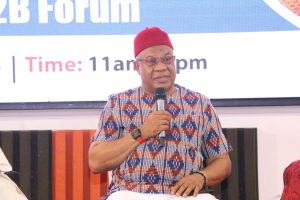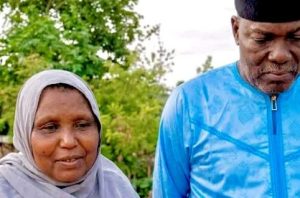
L-R: Dr Patrick Ijegbai, GM, BusinessDay Business Development, South-South/South-East; Mayor of Housing, My-ACE China; and Dr Dagogo Wokoma, Rivers SSG representing Gov Sim Fubara at the summit
Stakeholders in Nigeria’s real estate sector have renewed calls for the establishment of gas-powered industrial parks dedicated to the production of indigenous building materials, a move they say could significantly reduce construction costs and help tackle the country’s widening housing deficit.
The proposal formed a major outcome of the recent Real Estate Exhibition and Investment Summit held in Port Harcourt, Rivers State, bringing together industry leaders from the South-East and South-South regions.
Participants at the summit—including My-ACE China of the Mayor of Housing group, Mustapha Njie of TAF Africa Global, Bolaji Oshobukola of Odibola Properties Ltd, and Bishop Onyekachi Nzekwesi of Pineleaf Estate and Property Company—urged the Minister of Housing and Urban Development, who was represented at the event, to act swiftly on the recommendations.
Speaking after the summit, China, widely regarded as a real estate strategist, warned that Nigeria’s housing shortfall—estimated at about 22 million units—is worsening as population growth continues to outpace supply.
He outlined a three-pronged approach to reversing the trend, starting with the creation of energy-efficient industrial hubs for local materials production.
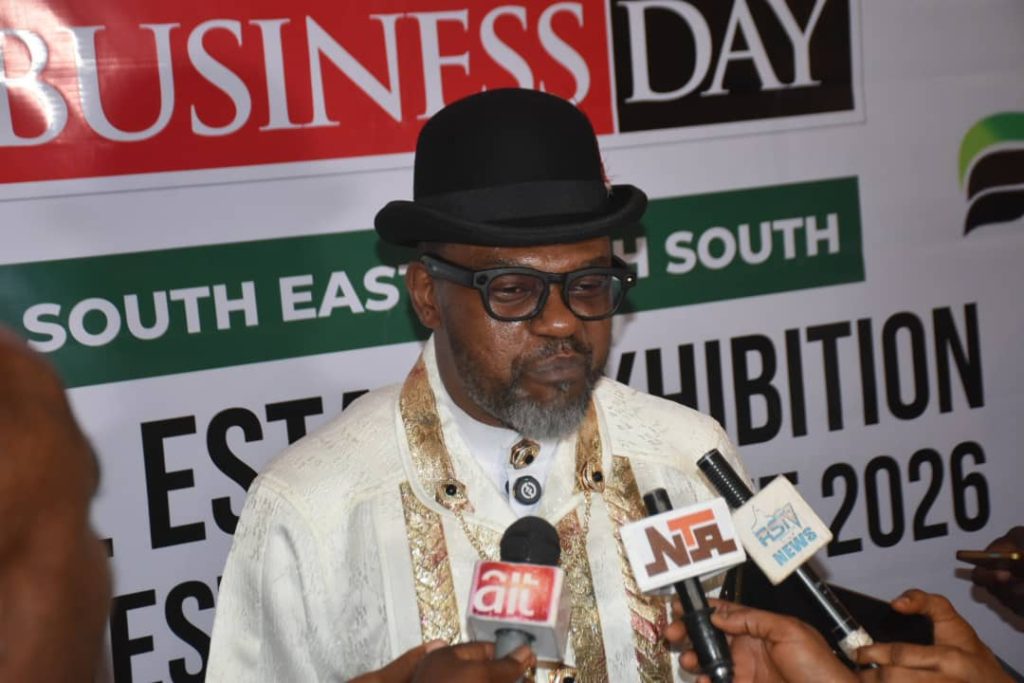
“Indigenous building materials must be produced through what the government can call housing free trade zones with zero tax and free duty plus low power cost as indigenous building materials parks,” he said. “As long as exchange rate is high, anything imported is out of the reach of the common man.”
China also emphasized the importance of non-political public-private partnerships (PPPs) to unlock land access and reduce costs.
“The second is public private partnerships (PPP) that are private, not political. Non-political PPPs will help government to bring in private developers and practitioners with proven record just like Rivers State has done so government can now subsidize the cost by providing land and title thus making the headache and cost of titling and land acquisition lower,” he said.
“When land acquisition and titling is taken off the equation, 40% of housing costs has already been removed.”
On the third pillar, he highlighted the need to improve the ease of doing business, particularly access to financing and global investment.
“The last or the third of the solutions that the government will need to put in place is of course the ease of doing business, both financing, access to global funds. It includes matchmaking of value versus practitioner, enabling established real estate developers to have an ease of doing business and to encourage more people to want to invest in real estate,” he said.
“When they invest, supply will be high. When supply is high, prices fall.”
He stressed that implementing these measures quickly would make the sector more attractive to investors, noting that limited access to credit remains a major bottleneck. “Most times the banks don’t lend to real estate and it makes doing real estate business very difficult,” he added.
China also raised concerns about Nigeria’s growing shift away from environmentally friendly housing, describing it as a move toward a “concrete desert.”
“It’s a movement that has left the green development and gone to what I call concrete desert because plants are expensive and Nigerians are usually in a hurry with a high taste and high requirement for affordability,” he said.
“At the Mayor of Housing, we believe that trees and human beings must coexist because trees breathe out oxygen and take in carbon dioxide which humans breathe out.”
He advocated legislation mandating tree planting in housing developments.
“So we are championing the renaissance and the return to green living and I believe there should even be a legislation for the minimum number of trees that must go with a house… So, that awareness needs to be created and I am not just advising the government.”
Highlighting ongoing efforts, he pointed to the Alesa Highlands Green Sustainable Smart City project.
“We have a project, Alesa Highlands Green Sustainable Green Smart City. We are building the lowest density green versus living area… we have to do a policy that encourages integrated horticulture,” he said.
“Integrated horticulture is horticulture for food, horticulture for medicine, and horticulture for beauty… but these days you hardly see that around houses. We need to have a renaissance, a green revolution of renaissance. I’m talking about green.”
He further described it as “appalling” that Africa, despite its abundant sunlight, is yet to lead in solar energy adoption.
“When God blessed the world to turn the heat and the brightness of sun to energy, Nigeria and Africa should be leading the green revolution for solar energy because we have more sunlight than we need,” he said.
“We have more heat than we need. Converting this to energy is part of what we call sustainability and that’s part of what we are putting in our project that is going to be the first, ‘zero emissions project’.”
China urged a return to traditional eco-friendly living patterns.
“Before now, our villages did not become a desert before it became a village. We lived with our trees… and we lived with our green canopy,” he said.
“It is high time we not only returned to that green canopy, but made sure that the concept of little green gardens and agriculture returned because the greatest wealth of the earth is the earth.”
On innovation, he described technology as central to modern real estate, while cautioning against uncritical adoption.
“Technology is the new reality. Technology is the new livelihood. Technology is the new neighborhood. Technology is the new environment. We can’t exist in the 21st century without technology,” he said.
However, he warned: “Technologies that are not indigenalized and localized for adaptability might just be a facade of luxury that is not practicable.”
“Our advocacy in the Mayor of Housing is that technology must play its role, but technology must be our servant and not our master because technology is an excellent servant for a terrible master.”
China also commended BusinessDay Media for hosting the summit but urged broader media collaboration to showcase investment opportunities in the region.
“BusinessDay is too big for me to advise… I only want BusinessDay to leverage their strength and bring other media houses to cover the event for the world to see the size of opportunity in the region,” he said.
Highlighting investment prospects, he noted: “If you check the housing projection for 2026, Port Harcourt stands as a 30% growth prospect versus Lagos, 20% and Abuja, 15%.”
He called on investors and government to open up the city’s economy.
“Open it. Loud it, especially to the investors. The best time to come is when the thing is green… Now that there are still bushes, every investor should rush in and turn their green to green money.”