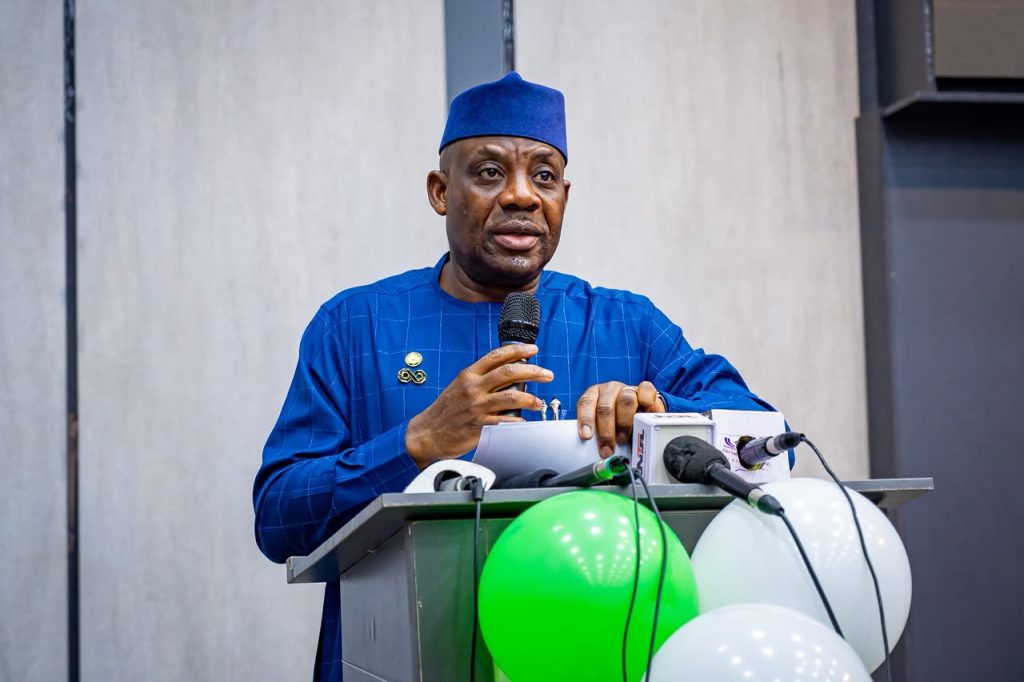
Minister of Education Tunji Alausa
Minister of Education, Dr. Maruf Tunji Alausa, has urged State Universal Basic Education Boards (SUBEBs) and other stakeholders in the education sector to make effective use of the digital learning platforms developed by the Federal Ministry of Education to enhance learning outcomes nationwide.
The Minister made the call on Tuesday in Abuja at the Federal Ministry of Education/Universal Basic Education Commission (UBEC) Roundtable Convening Meeting on Digital Resources Available to Achieving Learning Outcomes.
He lamented that many schools across the states were yet to fully utilise the ministry’s digital education resources, warning that the situation was undermining efforts to improve learning outcomes.
Maruf identified the available platforms as the Nigeria Learning Passport, Inspire, Ignite, EduRevamp, E-Learn, the Greenfield Learning Management System and virtual classroom solutions, among others, adding that they were created to support conventional classroom instruction rather than replace teachers.
According to him, the digital resources provide curriculum-based lessons delivered by some of the country’s best educators and can help address the shortage of qualified teachers, especially in subjects such as Mathematics, English Language, Physics and Chemistry.
He added that schools experiencing shortages of subject teachers could leverage the platforms to connect students with live or recorded virtual lessons, enabling learners to interact with teachers online and seek clarification where necessary.
“We have so many learning platforms…., they are all available on the Federal Ministry of Education website, open for your use.
“Just go there, and you can use this to support education in your states. We also have so many platforms available for teachers as well,” the minister said.
Expressing concern over the limited integration of technology into basic education, Alausa called on SUBEBs chairmen and state commissioners for education to place greater emphasis on digital learning in their respective states.
“You have a privileged position, being the chairman of SUBEB and being a commissioner for education, to change and direct the way education is being delivered in your various states,” he said.
The minister stressed that Nigeria must urgently adopt technology-driven education to reverse the country’s high level of learning poverty.
“Learning poverty means that by the age of 10, a child cannot read and understand an age-appropriate text. In Nigeria today, three out of every four children are learning poor. That is simply unacceptable,” Alausa said.
He noted that the statistics highlighted the need for a comprehensive transformation of teaching and learning through digital technology.
“We don’t have a choice. We have to use technology. It is no longer feasible to continue to do things manually. Digital learning is the future, and we must deploy it to every part of the country, including the most rural communities.”
Earlier, UBEC Executive Secretary, Dr. Aisha Garba, said technology has become a critical tool for building an inclusive, resilient and future-ready education system.
She disclosed that the commission has established digital learning centres in primary and junior secondary schools, deployed smart interactive boards, strengthened education data systems and introduced digital monitoring and evaluation platforms.
Garba further revealed that UBEC has inaugurated Digital Champions to spearhead digital transformation within the commission and assist state governments in implementing education technology initiatives.
She, however, maintained that technology alone would not deliver the desired transformation without effective coordination, strategic partnerships, continuous capacity building and the commitment of stakeholders to embrace innovation.
According to her, the roundtable was organised to strengthen collaboration among the Federal Ministry of Education, UBEC, state ministries of education, State Universal Basic Education Boards and development partners with the aim of accelerating the adoption of digital learning resources across the country.
The meeting also featured demonstrations of the ministry’s digital learning platforms as well as interactive question-and-answer sessions with participants.