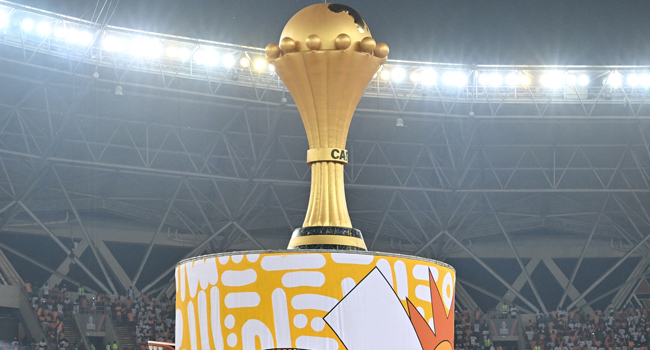
AFCON trophy
African football is set for a historic shake-up as the Confederation of African Football (CAF) has confirmed that the Africa Cup of Nations (AFCON) will move from its long-standing two-year cycle to a four-year format after the 2028 edition.
CAF President Patrice Motsepe announced the landmark decision on Saturday, describing it as part of a broader effort to align African competitions with an increasingly congested global football calendar.
Speaking to journalists in Rabat, on the eve of the opening match of the Morocco-hosted tournament, Motsepe explained that the change would help African football strike a better balance between competitiveness, player welfare and financial sustainability.
“Our focus now is on this AFCON, but in 2027 we will be going to Tanzania, Kenya, and Uganda, and the AFCON after that will be in 2028,” Motsepe said. “Then after the FIFA Club World Cup in 2029 we will have the first African Nations League… with more prize money, more resources, and more competition.
“As part of this arrangement, the AFCON now will take place once every four years.”
For decades, AFCON has been staged every two years—a tradition dating back to the inaugural tournament in 1957. While the frequent schedule became a major source of revenue for national associations, it also created recurring clashes with European leagues and FIFA competitions, a challenge that has intensified over the past 15 years.
CAF believes the introduction of an annual African Nations League, modelled after UEFA’s successful competition, will help fill the financial gap left by fewer AFCON tournaments, while also raising the overall standard of competition on the continent.
This year’s tournament in Morocco marks the eighth AFCON edition since 2012, when the competition was co-hosted by Equatorial Guinea and Gabon.
With the new four-year cycle and the launch of the African Nations League, CAF says African football is entering a new era—one designed to be more competitive, more lucrative, and better aligned with the global game.