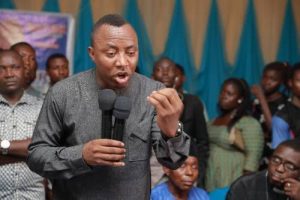
Prof Iyorwuese Hagher (middle) addressing a press conference on Thursday in Abuja
Worried by the grave humanitarian tragedy that has affected the people of Benue State since 2015, Prof Iyorwuese Hagher has called on the Federal Government of Nigeria to declare a state of emergency in the Sankera axis of Benue State and deploy sufficient, rights-respecting security forces to restore control of the territory.
At a press conference in Abuja on Thursday, tagged ‘ _Exposing the Genocide in Benue State: The Sankera Holocaust’,_ Hagher decried the alarming scale of human loss and suffering across Benue, warning that the state, once a pillar of agricultural productivity and economic stability, is now descending into lawlessness and despair.
He therefore urged the Federal Government to ensure the safe return of all internally displaced Sankera people to their ancestral homes and protect their lives from bandits and terrorists.
According to him, the Federal Government should establish an Independent Judicial Peace and Reconciliation Commission to investigate the root causes, document atrocities, ensure accountability, and provide a framework for retributive and restorative justice.
“The African Union and ECOWAS should conduct an independent fact-finding mission. The United Nations Human Rights Council should urgently review the situation”.
He also called on the International humanitarian agencies to scale up assistance for internally displaced persons and host communities.
“The Federal Government should secure the large ungoverned space between Kasar and Agu-centre by establishing a robust army battalion in Kasar and organise a large-scale resettlement scheme in Sankera by establishing new modern towns with modern amenities, such as schools, hospitals, and police stations, instead of having people living scattered across the land in precarious circumstances.
“Most importantly, I call upon humanity’s conscience. What I witnessed on February 18 was not merely abandonment. It was erasure. If fifty square kilometres of once-thriving communities can vanish in silence, the world’s moral architecture is at risk”, he said.
“We cannot normalise empty villages. We cannot normalise orphaned farmland. We cannot normalise children growing up, abused and traumatised, without a memory of home or access to education”.
“I wish to draw the world’s attention to crimes against humanity and genocide committed against the people of Sankera in Benue State, in which over 2,603 lives have been lost”.
Prof Hagher noted that a total land area occupied by Fulani herdsmen and bandits is estimated at 3580.11 square km, about 58.93%, and over half a million people have lost their means of livelihood through forced displacement.
“To put the genocide in perspective: the Sankera, a chiefdom in the north-east of Benue State with a landmass of 6075 km², is larger than Ebonyi, Imo, and Anambra States. The scale of this genocide is undeniable, and those denying its ethnic nature are insensitive, callous, and criminally liable”.
“I am addressing this press conference because, for too long, our people have endured a sustained campaign of violence, displacement and destruction, constituting one of the most severe humanitarian crises in contemporary Africa”.
He lamented that, for too long, those in power have denied the existence of these crimes against humanity and instead appear to support mass killings of the people and sympathise with terrorists.
Hagher bemoaned the recent request by the Benue State Government for federal government approval to establish a centre specifically for the rehabilitation of bandits, without first returning the displaced victims to their homes or meting out justice in accordance with the law, normalises criminality and weaponises politics, seemingly curating and deploying bandits for political purposes.
He argued that while the Bola Ahmed Tinubu government is partnering with the US government to bring succour to the victims of terrorism, the Benue State government is urgently seeking accommodation with the terrorists who have yet to be reconciled and forgiven by their victims, in line with global best practice.
“This is a sad misplacement of priorities and a preference for terror and banditry over the victimised, brutalised, and traumatised”.
“The Sankera genocide is dangerously under-reported. The State government has deployed its substantial financial security vote to conceal and deny the suffering of the Sankera people. By doing so, the State government bears criminal liability for genocide denial and for protecting the perpetrators”.
“The Convention on the Prevention of the Crime of Genocide, which Nigeria signed on 27th July 2009, condemns those who witnessed genocide and, instead of defending the victims, colluded. Official silence and denial of the Sankera Holocaust have deepened the wounds. Inadequate documentation has obscured the scale of the suffering, and political hesitation has prolonged it, he added.