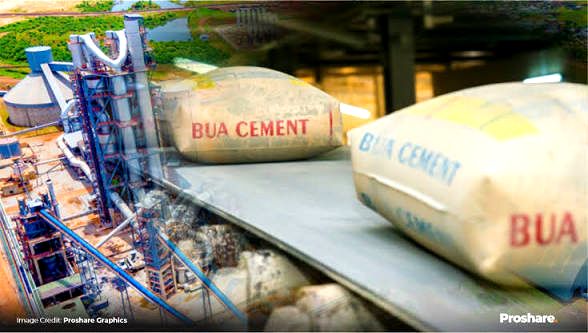
BUA Cement Plc has said its cement prices would decline as production and logistics costs ease.
Speaking at the company’s 10th Annual General Meeting in Abuja on Thursday, Group Chairman, Abdul Samad Rabiu said recent economic reforms, particularly the stabilisation of the foreign exchange market, are improving planning and reducing cost pressures for manufacturers.
The Chairman attributed recent increases in cement price to foreign exchange depreciation, surging energy costs, and higher transportation expenses rather than excessive profit-taking.
He lamented that the cement industry remains highly exposed to exchange rate movements due to reliance on imported spare parts, energy inputs, and other production requirements.
Rabiu explained things will turn around for good due to the sound polices and reforms in the economy. He noted that while naira devaluation created challenges, recent exchange rate stability has improved business planning and is already contributing to lower prices for some commodities.
“The good news is that things are getting better because of the stability. You see, the price of certain commodities is coming down, especially shipping prices,” he said.
Rabiu added that cement prices in Nigeria remain competitive compared to neighbouring markets where Nigerian producers export. He said the foreign exchange reforms, though painful initially, created a more transparent market and removed distortions that had made access to foreign currency difficult.
“Today, whatever rate I get, it’s the same rate anybody gets,” he stated.
Rabiu noted that exchange rate stability will enhance proper planning and forecasting by manufacturers.
Expansion plans advance despite headwinds
BUA Cement is pressing ahead with major expansion projects. Managing Director Binji said the company’s new production line in Ososo, Edo State, is nearing completion, while another line in Sokoto has been announced.
The projects will add about six million tonnes to annual production capacity, raising total installed capacity to 23 million tonnes per annum by the end of next year.
“We are going to add about six million tonnes per annum to our capacity. That is going to bring us up to 23 million tonnes per annum,” Binji said.
He said demand remains strong, supported by road and infrastructure projects nationwide. To meet demand, BUA has invested in bulk cement distribution and acquired 500 specialised trucks, all currently deployed. The company is considering buying another 500 trucks due to rising demand from projects like the Lagos-Calabar Coastal Highway.
BUA has also temporarily reduced exports to prioritise local supply as domestic consumption rises. Despite insecurity in some areas, Binji said the company will continue to invest and expand.
“Our major aim is to be able to deliver cement everywhere in Nigeria at affordable prices, and that is what we will continue to do,” he said.
BUA’s cement lines expansion could shift both market share and pricing dynamics in Nigeria’s cement industry quite a bit.
In terms of capacity jump and market share,
BUA currently operates at about 17 million tonnes per annum across its plants. The new lines in Ososo, Edo and Sokoto will add 6 million tonnes, bringing total installed capacity to 23 million tonnes by end of 2027.
For context; Dangote Cement sits at roughly 52 million tonnes across Nigeria and Africa, with about 35 million tonnes in Nigeria alone. Lafarge Africa is around 10-11 million tonnes.
Analysts predict if Nigerian domestic demand stays near 30-32 million tonnes per year, BUA’s 23 million tonnes would give it roughly 72% of current demand on a capacity basis. That does not mean it will sell that much immediately, but it would put BUA in a position to compete much harder for market share, especially in the North and Midwest where the Sokoto and Edo plants are located.
In terms of pricing impact, cement pricing in Nigeria is driven by three factors; FX costs, energy costs, and logistics. BUA’s chairman said prices will drop when those ease and this can be achieved with BUA’s investments in energy infrastructure and local sourcing. Also, more local supply means less reliance on imports and less FX demand for cement, which historically pushed prices up during naira volatility.
Analysts forecast if BUA runs the new lines at high utilisation and keeps distribution costs down via its 1,000-truck fleet, it can undercut on price in target regions without eroding margins as much as smaller players. That creates pricing pressure on Dangote and Lafarge in overlapping markets.
BUA’s planned expansion will bring about regional shift as well. Market analysts predict the Sokoto line will strengthen BUA’s hold in Northern Nigeria, where logistics costs from the South are high. The Ososo line will give it better access to the Midwest and South-South, directly competing with Dangote’s Okpella and Lafarge’s Mfamosing plants.This expansion means price competition will not be national and uniform. Analysts expect sharper price drops in regions close to BUA’s plants first, with lag effects elsewhere.
Nigerians are lamenting high cost of cement as it affects construction and even goes as far as increasing the rents of tenants, citing prices as high as N12, 500 – N13,000 per 50kg bag, the latest announcement by BUA to expand cement lines, compete directly with other companies and reduce cost is a welcome relief. However, analysts warn that capacity alone does not guarantee lower prices. If energy costs rise again or the naira weakens, the cost advantage shrinks. Also, demand is tied to government infrastructure spending. BUA cited projects like the Lagos-Calabar Coastal Highway as demand drivers, so any slowdown there caps how fast new capacity gets absorbed.