Civil Society Organisations (CSOs) under the European Union Support to Democratic Governance in Nigeria Phase Two (EU-SDGN II) programme has disclosed that the state of election preparedness across the 16 INEC LGA offices in Ekiti State governorship election stood at 34% as of 14 April 2026.
They raised serious concerns over the preparedness of the Independent National Electoral Commission (INEC) for the June 20, 2026 Ekiti State governorship election, alerting that the poll could face a major challenges if urgent measures are not taken.
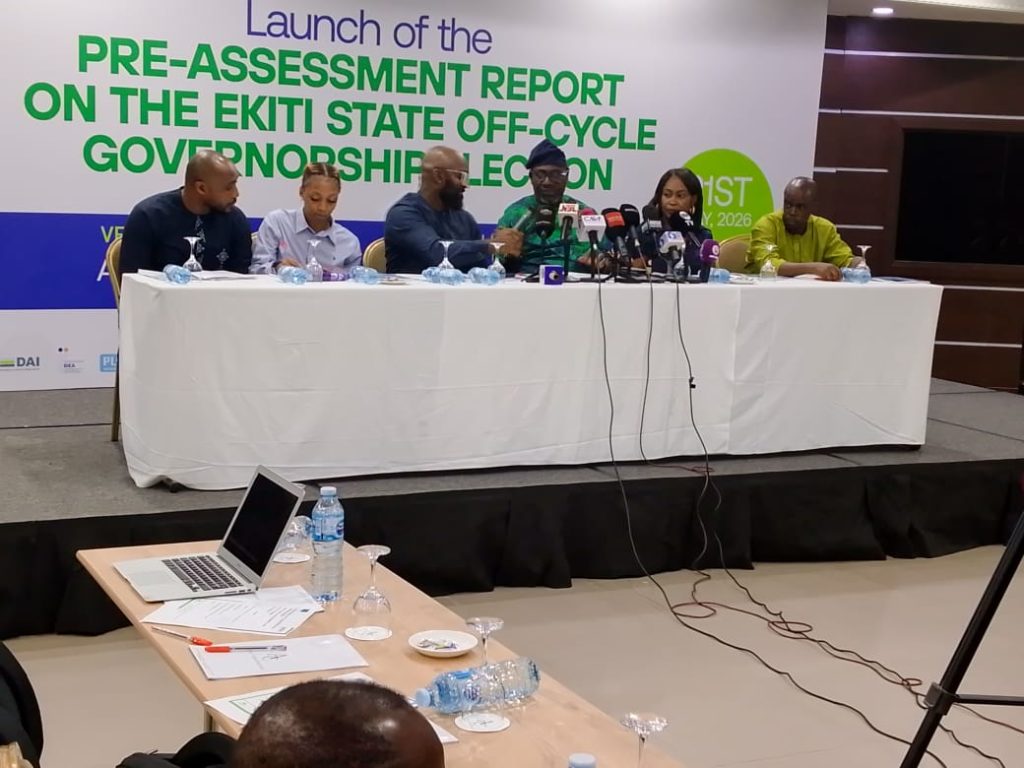
Presenting a Pre-Election Assessment Report at a media briefing in Abuja, on Thursday Executive Director of the International Press Centre, Lanre Arogundade, speaking on behalf of the Election Observation Hub, disclosed that INEC’s election preparedness across the 16 local government offices in Ekiti stood at only 34 per cent as of April 14, 2026.
The civil society groups described the situation as an “operational emergency,” stressing that with barely 36 days to the election at the time of assessment, the commission’s level of preparedness was “structurally incompatible with the conduct of a credible election.”
The report observed that the INEC office in Ekiti State had yet to receive election funding, while several state and local government offices, operational vehicles and collation centres required urgent rehabilitation.
Although Continuous Voter Registration had been concluded and activities such as BVAS inventory checks, network mapping and stakeholder engagements were ongoing, the organisations warned that such efforts could not compensate for the absence of core funding and critical infrastructure.
The groups further observed that, though the atmosphere was relatively peaceful in the state, the election was widely perceived as non-competitive due to the dominance of incumbency, opposition disunity and an alleged elite consensus around the sitting governor.
“A peaceful and non-competitive election is not automatically a democratic one,” the report stated.
The assessment identified Ado-Ekiti, Ikole, Moba and Ilejemeje as high-risk local government areas, citing threats including vote buying, political thuggery, kidnapping, disinformation campaigns and the possible militarisation of election security.
On security preparations, the Nigeria Police Force was said to have developed “Operation Order 08/2026,” proposing the deployment of 9,780 officers, 25 mobile police units, 200 patrol vehicles, 12 Armoured Personnel Carriers and three helicopters for the election.
However, the groups expressed concerns over possible politicisation, excessive use of force and welfare issues affecting security personnel.
The report therefore criticised what it described as shrinking political inclusion in the state, revealing that none of the 13 political parties fielded a female governorship candidate, while no candidate publicly identified as a person living with disability.
The CSOs blamed high nomination fees, entrenched patronage systems and informal political gatekeeping for the exclusion of women, youths and persons with disabilities from top-level political participation.
They also condemned the N5 million campaign signage levy imposed by the Ekiti State Signage and Advertisement Agency, saying it disproportionately affected opposition parties and weakened electoral competitiveness.
The Election Observation Hub urged INEC to urgently secure and deploy election funds, complete the rehabilitation of offices and collation centres, and fully test the BVAS and IReV systems ahead of the poll.
The groups also called on security agencies to maintain neutrality and professionalism, while urging political parties to reject vote buying, violence and inflammatory rhetoric.
“The credibility of the election will be determined not by the absence of violence alone, but by the transparency, inclusiveness and public acceptance of the outcome,” the report concluded.
The assessment was signed on behalf of the Election Observation Hub by the Centre for Media and Society (CEMESO), Yiaga Africa, The Kukah Centre, the International Press Centre, ElectHER, Nigerian Women Trust Fund and TAF Africa.