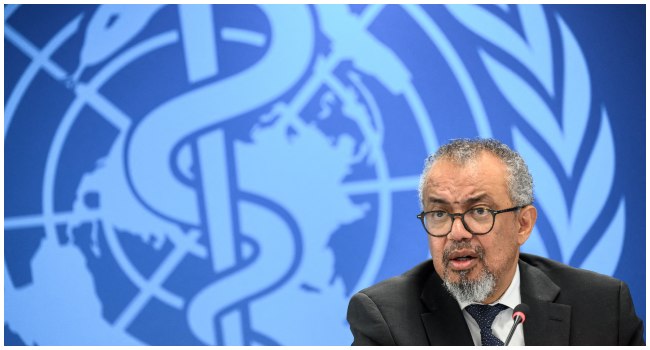
World Health Organization (WHO) Director-General Tedros Adhanom Ghebreyesus speaks during a press conference on Ebola outbreak in Democratic Republic of Congo and Uganda, in Geneva, on May 20, 2026. (Photo by Fabrice COFFRINI / AFP)
World Health Organization has raised the Ebola risk level in the Democratic Republic of the Congo from high to “very high” following a rapid increase in suspected infections and deaths across the country.
WHO Director-General Tedros Adhanom Ghebreyesus disclosed on Friday that the outbreak had worsened significantly, with nearly 750 suspected cases and 177 suspected deaths already recorded.
“The Ebola outbreak in the Democratic Republic of the Congo is spreading rapidly,” Tedros said during a press briefing, adding that “we are now revising our risk assessment to very high at the national level, high at the regional level, and low at the global level.”
According to him, 82 Ebola cases and seven deaths have so far been officially confirmed in the DRC, while neighbouring Uganda has reported two confirmed imported cases, including one fatality.
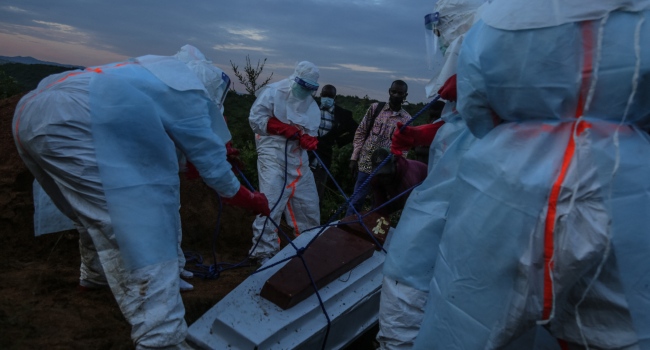
Health officials said worsening violence and insecurity in affected communities are making efforts to contain the outbreak more difficult.
Tension erupted at Rwampara hospital in Ituri province after angry residents and relatives of victims set ablaze tents used for isolating Ebola patients following the death of a 24-year-old man.
“It all kicked off when a 24-year-old man, the son of a soldier, died at the hospital,” a hospital official explained, adding, “The family wanted us to hand over his body so that they can bury him, but given the circumstances, that’s impossible.”
Medical experts warned that Ebola spreads through bodily fluids and close physical contact, while the Bundibugyo strain behind the latest outbreak currently has no approved vaccine or treatment.
Community leaders also expressed concern over unsafe burial practices, with Jean Marie Ezadri saying, “Loved ones are throwing themselves at the bodies, touching the corpses and the clothes of the deceased, while organising mourning rituals bringing together loads of people.”
Despite repeated warnings from health authorities, some grieving relatives rejected the Ebola diagnosis, as 22-year-old Jeremie Arwampara insisted, “My brother is not dead from Ebola, it’s an imaginary disease,” while another mourner, Ezekiel Shambuyi, shouted, “Why are they refusing to give us the bodies? He’s my big brother, I cannot be afraid of him.”
AFP