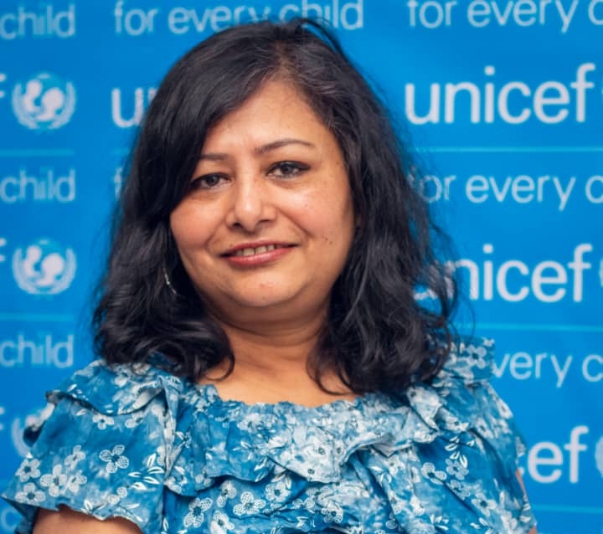
United Nations Children's Fund (UNICEF) WASH Manager in Maiduguri, Mamita Bora Thakkar
By SADIQ ABUBAKAR, Maiduguri –
The United Nations Children’s Fund (UNICEF) WASH Manager in Maiduguri, Mamita Bora Thakkar, speaks on the impact of improved menstrual health and hygiene management for schoolgirls and the expectations from government in facilitating an enabling environment for girls to achieve.
Q1. What efforts has UNICEF made in supporting Nigerian school-aged girls to achieve a stress-free menstruation?
A1. It is important to first establish the context of UNICEF’s work on Menstrual Health and Hygiene Management services (MHHM). UNICEF’s support to menstrual health and hygiene is aimed at improving outcomes on education, health, and gender equality for girls and women. We believe that menstrual health and hygiene is fundamental to the dignity and wellbeing of women and girls and an important part of the basic hygiene, sanitation, and reproductive health services to which every woman and girl has a right. When appropriate menstrual health and hygiene management services are available, it can address barriers to education, health, livelihood, dignity and empowerment of adolescent girls. Specifically, achieving these goals requires addressing interrelated determinants of social support, knowledge and skills, facilities and services, materials and supplies, along with improvements in the enabling environment through appropriate policies, coordination, financing, capacity building, and monitoring in the education, health, and WASH sectors. Because of its transformational potential, MHHM is one of UNICEF’s five interlinked priorities for empowering adolescent girls in its Gender Action Plan, which is UNICEF’s commitment to achieving gender equality and girls’ empowerment.
In line with UNICEF’s programming framework for MHHM in Nigeria, especially in the Northeast states, UNICEF has supported states to improve access to gender disaggregated toilets and water facilities with proper handwashing stations in schools, so that girls can manage menstruation in privacy and with dignity. Girls’ friendly toilet designs have been standardised, which now guides the implementation of these infrastructure. UNICEF has supported training of teachers through special modules targeted at building knowledge and skills on MHHM. This module is embedded within ‘Teachers’ Training Manual on Hygiene Promotion in and Through Schools,’ adopted by the Government. In addition, in order to improve access to pads, in many of the IDP camps in the NE, UNICEF is actively supporting training of the girls and female teachers on the local production of reusable sanitary pads. At the Federal Level, UNICEF has supported the establishment of the Technical Working Group on MHM, housed under the Federal Ministry of Women’s Affairs, envisaged to provide strategic leadership on the issue, at the national level.
Q2. What are the challenges identified from the research on MHHM in schools?
UNICEF supported a study in selected schools in Nigeria, to understand the barriers that schoolgirls face in managing menstruation, and the associated challenges with regards to the enabling environment. Findings from this study showed that challenges are many, including those related to beliefs and cultures that cut across religion and ethnicity. The study revealed that availability, adequacy and access to WASH facilities, adequacy and flow of information on MHM and access to materials for hygienic management of menstruation impacted girls’ experience of menstruation. School WASH facilities were inadequate for menstrual management, with most of the latrines observed were dirty with broken doors and poor ventilation, while the ratio of pupil to toilets was very high.
Most significantly, girls lacked knowledge about puberty and menstruation. Most the girls stated that they had no prior knowledge about menstruation before menarche. Even after the onset of menstruation, information on menstruation was from mothers, older siblings and peers. There were inconsistencies in the subjects that addressed menstruation as well as information shared in schools. The teachers, especially those in co-educational schools were uncomfortable to teach menstruation and menstrual hygiene. Most girls believed that menstruation was a secret and unclean experience and expressed special fear that used menstrual materials could be taken for rituals that could cause harm to menstruating girls. In addition, girls faced fear, confusion, anxiety, misconceptions, cramps, nausea, dizziness, general discomfort, headache, vomiting, loss of appetite, waist and stomach pains.
Poor concentration, distraction, absenteeism, missed educational opportunities, self-exclusion, self-restrictions was quite evident amongst the girls. The worry here is all of this put girls at greater potential risks of early or child marriage, early sexual debut, teenage pregnancy, harassment and school dropout.
Q3: What is the way forward in order to address the issue of MHHM amongst schoolgirls?
A3. We recognize that adolescence is a time of tremendous opportunity, while also being a time of heightened vulnerabilities, and the issue must be tackled holistically. UNICEF’s study and also global evidence points out to multiple and multi-level barriers like insufficient knowledge, guidance and skills amongst school girls, inadequate access to basic WASH services in school and also in communities, inadequate access to affordable and appropriate menstrual materials, unsupportive and patriarchal attitudes and social norms around menstruation leading to stigma, myths and taboos coupled with weak enabling environment of poor resource allocation, weak policies and low political will. We need multiple levels of interventions from national to subnational to community and individual level. Within a more holistic definition of MHHM intervention lie rigorous measurement of standard indicators, building evidence base on effective MHHM approaches for entrepreneurs, policy makers, funders and investors of menstrual products, MHHM education and information to girls, availability of adequate numbers of safe, clean, private water and sanitation facilities, bathing and laundering spaces for girls and women to clean themselves, access to menstrual products as well as effective disposal options and waste management systems for the hygienic handling of menstrual waste. We need special efforts to reach and co-design solutions with girls with disabilities, girls from minority groups and those in conflict situations.
Q4: In your opinion, is the government doing enough to promote a better menstrual hygiene management in schools?
A4: In northeast Nigeria, UNICEF is supporting the government to strengthen the enabling environment through appropriate policy and program framework that can potentially address the gaps as mentioned. UNICEF strongly believes that the government must provide a strong leadership in policy and program implementation, resource allocation and in monitoring progress. In its technical support role, UNICEF is leveraging its global and national experience to support northeast states in Nigeria with the establishment of a Technical Working Group. This will help define key policy and programme results, develop a basic minimum MHHM package in schools, help strengthen monitoring indicators, build capacities amongst partners, support advocacy, while also establishing models for ‘at scale’ programming.