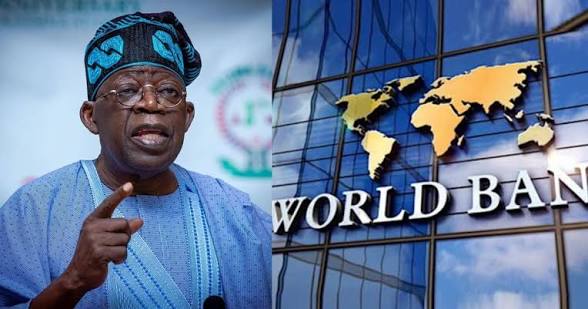
President Bola Tinubu and World Bank logo
Nigerian Government has officially cancelled $717.7 million in undisbursed World Bank financing aimed at reviving the country’s electricity sector.
According to the report on Channels TV attributed to the World Bank, this decision follows delays in meeting key reform milestones and significant shifts in the sector’s operating environment, leading to a joint agreement with the World Bank to terminate the remaining balance of the Power Sector Recovery Performance-Based Operation.
The cancelled amount represents the undisbursed portion of a $1.52 billion programme approved between 2020 and 2023 to improve Nigeria’s power infrastructure and financial viability.
The World Bank confirmed on Tuesday May 26 that no further disbursements will be made under the programme following this restructuring.
Recall that the initial $752.5 million financing, approved on June 23, 2020, was designed to restore financial health to Nigeria’s power sector by addressing tariff shortfalls, improving operational performance, and strengthening regulatory oversight. An additional $763.5 million was approved on June 9, 2023, to build on initial gains and extend the project’s timeline to June 30, 2027.
While the original programme fully disbursed and met its performance indicators, the additional financing stalled due to unmet critical reform conditions.
The World Bank highlighted that the programme’s design became increasingly misaligned with Nigeria’s evolving realities, particularly after two major shocks: the liberalization of foreign exchange in June 2023, which sharply increased gas costs for power generation, and a freeze on electricity tariffs for most consumers. Given that over 70% of Nigeria’s grid electricity is gas-fired and priced in dollars, these shocks severely impacted the sector’s financial dynamics.
Despite setbacks, the parent programme yielded notable improvements. Tariff shortfalls decreased by 71% from N581 billion in 2019 to N166 billion in 2022. Regulatory cost recovery improved from 56% to 94%, and electricity supplied to the grid rose by 13% between 2018 and 2021.
However, persistent challenges remained, including high technical and commercial losses in electricity distribution, weak transmission capacity, underutilized generation assets, and inadequate cost recovery. These issues continue to create financing gaps and liquidity pressures throughout the power value chain.
The cancellation decision follows warnings from Nigeria’s Accountant-General, Dr. Shamseldeen Ogunjimi, who cautioned that prolonged delays in loan approval and disbursement could lead the government to reject future World Bank loans. Speaking in Abuja, Ogunjimi emphasized that delays exceeding six months undermine project execution and fiscal planning, stating, “If approvals take more than six months, the Nigerian Government may no longer honour such arrangements.”
In light of these developments, the World Bank has moved the programme’s closing date forward from June 30, 2027, to May 31, 2026, effectively ending the initiative more than a year earlier than planned.
The loan cancellation marks a significant shift in Nigeria’s approach to power sector financing and highlights the complex challenges of aligning international financing programmes with rapidly changing domestic economic conditions.
The government and stakeholders will need to explore alternative strategies to address the persistent issues in Nigeria’s electricity sector.