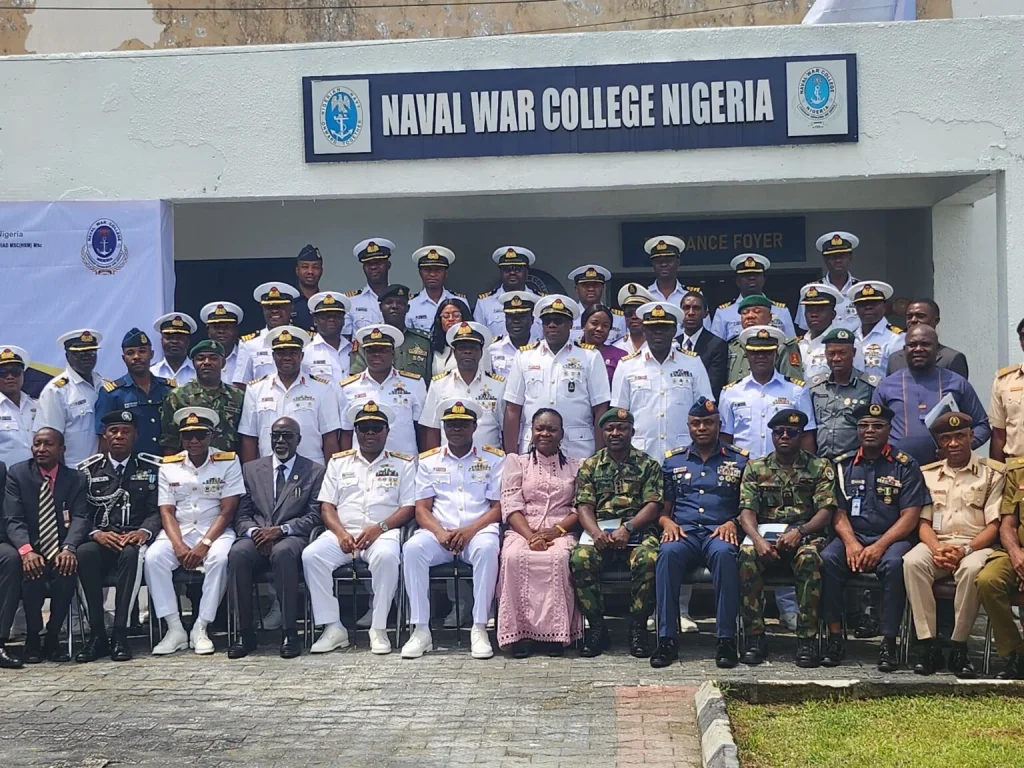
Group photograph of participants at the Naval Warfare Course 9 Inter-Agency Seminar hosted by the Naval War College in Calabar on Thursday.
National Centre for the Control of Small Arms and Light Weapons (NCCSALW) has revealed that Nigeria accounts for 70% of the estimated 11 million illicit small arms and light weapons circulating in West Africa.
This disclosure was made by Mr. Alex Ebimiebo, the South-South Zonal Director of NCCSALW, during a presentation at the Naval Warfare Course 9 Inter-Agency Seminar hosted by the Naval War College in Calabar on Thursday.
His paper, titled “ _Enhancing Security Agency Collaboration to Curb Illicit Arms Proliferation for Improved National Security in Nigeria_ ,” highlighted the severe implications of illegal arms trafficking.
Ebimiebo noted that the proliferation of these weapons is a major driver behind Nigeria’s 2.2 million internally displaced persons (IDPs) and 26,000 refugees in neighboring countries.
He also pointed out that the spread of illegal arms fuels economic disruptions, escalates violence and crime, and hinders peace-building efforts.
He called for a unified national effort to address the issue, stressing that security is a collective responsibility. “The fight against illicit arms requires the involvement of all Nigerians.
The NCCSALW is committed to engaging communities through advocacy and sensitization programs, alongside collaboration with other security agencies,” Ebimiebo said.
Commandant of the Naval War College, Rear Adm. Akinola Oludude, expressed alarm over the surge in illicit arms entering Nigeria since 2020.
He attributed this to the country’s porous 4,470-kilometer land borders with Benin, Niger, Chad, and Cameroon, as well as its 853-kilometer coastline along the Gulf of Guinea.
According to a 2021 NCCSALW survey, over six million illegal weapons are in circulation within Nigeria, with approximately 70% controlled by non-state actors.
Oludude emphasized that the proliferation of these arms fuels various forms of insecurity, including terrorism, banditry, kidnapping, communal conflicts, and armed robbery.
He advocated for a collaborative, multi-agency approach, stating, “No single agency can tackle this complex challenge alone, regardless of its resources or dedication.”
He described the seminar as a critical platform for addressing the issue collectively.
Flag Officer Commanding, Eastern Naval Command, Rear Adm. Kennedy Ezete, urged participants to translate the seminar’s discussions and recommendations into actionable steps.
He encouraged them to apply the insights gained within their respective agencies and organizations.
“The strategies developed here must be implemented effectively, and the partnerships formed must be sustained,” Ezete said.
He also stressed the importance of continued investment in training, technology, and intelligence to strengthen efforts against illicit arms proliferation.
NAN