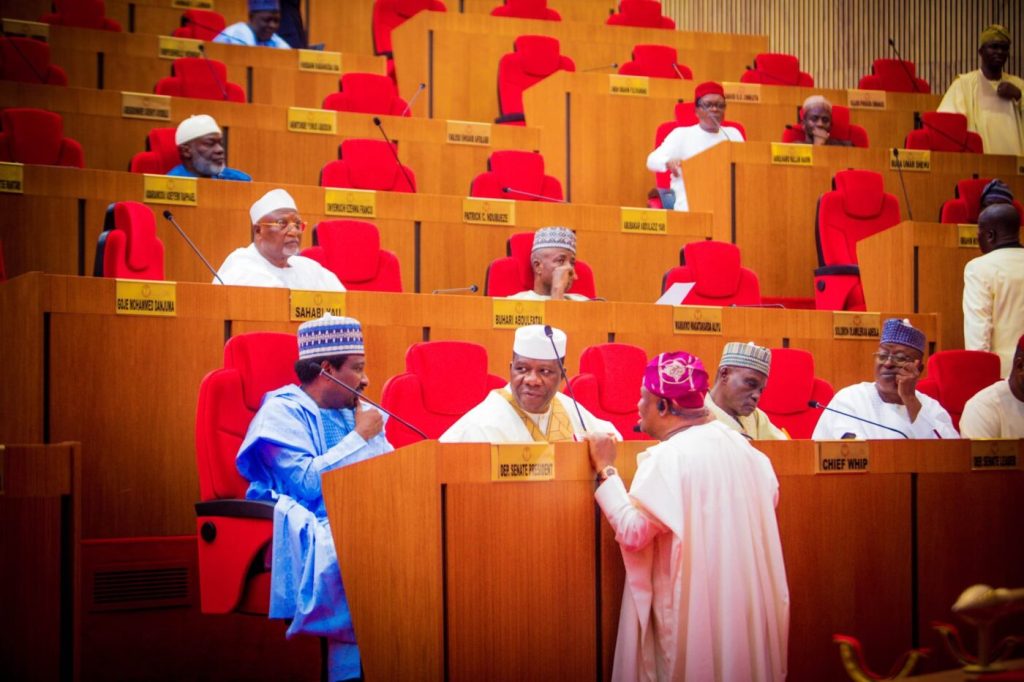
Several Nigerian senators have pushed for a significant shift in the country’s electoral process, advocating that the Independent National Electoral Commission (INEC) bear full responsibility for proving the legitimacy of election results during legal disputes.
This call was made during Wednesday’s Senate plenary as lawmakers resumed discussions on a proposed bill to repeal the Electoral Act No. 13 of 2022 and replace it with a new Electoral Act 2025, aimed at regulating elections at federal, state, and area council levels.
The debate had previously been suspended on October 16, with senators citing the need for broader consultations and a deeper understanding of the bill’s provisions before moving forward.
Leading the discussion, Senate President Godswill Akpabio emphasized that INEC must be accountable for every election it conducts, stating, “They are in charge of logistics and electoral materials, every action at the election, and so, they should be able to prove and validate the outcome of every election.”
He argued that the electoral umpire should not shift the burden of proof to aggrieved candidates or parties but must instead defend the integrity of its own processes.
Supporting this view, Senator Seriake Dickson (PDP–Bayelsa) insisted that INEC alone should carry the legal burden in election disputes. He also called for greater investment in electoral technology such as the Bimodal Voter Accreditation System (BVAS), along with increased funding for the commission to strengthen its capacity.
Senator Lere Oyewumi (PDP–Osun) urged for harsher penalties against electoral offenses to deter malpractice, while Senator Mohammed Monguno (APC–Borno) stressed the importance of transparent party primaries. He called for regulations to limit excessive campaign spending and curb vote-buying.
Highlighting the potential of diaspora participation, Senator Garba Maidoki (APC–Kebbi) proposed mechanisms to allow Nigerians abroad to vote, citing their economic contributions through remittances as a basis for inclusion in the democratic process.
Senator Adamu Aliero (APC–Kebbi) called for clarity in the law to eliminate contradictions and pushed for reforms that would allow elected officials to be included in delegate lists for party primaries. He also championed enhanced use of BVAS and other digital tools to ensure credible elections, adding, “Let us work to improve the BVAS, to announce whatever is the election results.”
Other senators, including Orji Uzor Kalu (APC–Abia) and Ali Ndume (APC–Borno), echoed the need for technological upgrades to bolster the credibility and transparency of the electoral system.
Following its second reading, the bill was forwarded to the Senate Committee on INEC for more detailed legislative work.
NAN