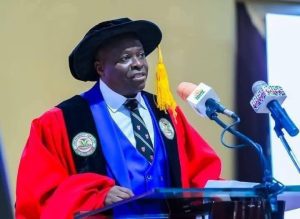
As Moses Orshio Adasu University, Makurdi (MOAUM) prepares to usher in a new Vice Chancellor, strong indications suggest the incoming administrator will face a mix of high expectations and pressing challenges.
The current Vice Chancellor, Professor Joe Tor Iorapuu, whose tenure officially ends in early November, has been on leave for several months. In his absence, the Deputy Vice Chancellor (Academics), Professor Simon Terver Ubwa, has held the reins in an acting capacity—a role he is set to vacate in the coming weeks.

Our investigation across the campus reveals that while the outgoing leadership has recorded some progress, sustaining and expanding these gains will be a herculean task for the next VC.
Infrastructure: Gains and Gaps
One of the most visible improvements on campus in recent months is the steady power supply.
Students across departments testified to a consistent electricity presence, even during general public outages.
A Radiography student, who requested anonymity, said, “Even when there’s no light in town, we still have power on campus. It’s made studying easier.”
A Political Science student echoed this sentiment, adding that lecture halls also benefit from the improved power situation.
Water supply, another long-standing concern, has seen notable improvement—especially in the hostels. However, students still complain about uneven distribution.
“We now have water more regularly, but some points are dry. You have to walk to other hostels sometimes,” a student lamented.
The university has also upgraded its lecture halls, replacing old, worn-out boards with new, more functional ones, aimed at improving the teaching and learning experience.
Welfare and Policy Challenges
Despite the progress, there are critical policy issues the new VC must address.
Staff welfare remains a major sore point, particularly among non-teaching unions. Members of SSANU and NASU continue to press for the full implementation of the national minimum wage, which has yet to be actualized.
Chairman of the university’s Joint Action Committee (JAC), Comrade Luper Shishi, emphasized: “The major grievance is the non-implementation of the minimum wage. Management must prioritize this if industrial harmony is to be maintained.”
Academic culture also needs urgent attention. Reports indicate that lecturer absenteeism has become a worrying trend in some faculties.
“There are lecturers who barely show up. It’s demoralizing,” a student said.
A controversial policy in the Department of Radiology has also drawn criticism. Currently, students who fail a course and earn a carryover are reportedly removed from the department and forced to switch programs. Some students have called for a more lenient approach, pleading for a chance to retake failed courses within their department.
What Lies Ahead
With visible improvements already in motion—such as upgraded facilities, improved utilities, and a more stable academic environment—the new Vice Chancellor will not be starting from scratch. However, they will be expected to consolidate these gains while tackling unresolved challenges head-on.
High on the agenda will be completing additional lecture halls and expanding hostel accommodations to meet growing student population needs.
Perhaps more importantly, the new VC will need to win the confidence of both staff and students, fostering a more responsive, inclusive, and accountable administration.
In a university named after a visionary leader, the bar is set high. The next Vice Chancellor must now rise to meet it.