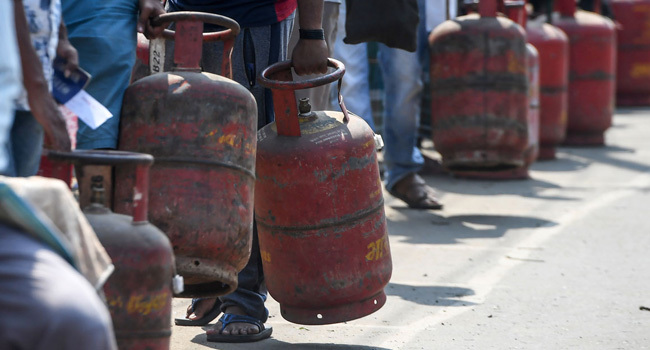
A file photo of a 25kg cooking gas jar
Weeks after the Federal Government vowed to tackle the rising price of Liquefied Petroleum Gas (LPG), commonly called cooking gas, Abuja residents say the product is still selling at steep rates.
A News Agency of Nigeria (NAN) market check on Sunday revealed that roadside retailers continue to sell LPG for as much as ₦1,800 per kilogram, far above the government’s anticipated price reduction.
According to NAN, the cost of cooking gas had jumped from ₦1,100 to ₦1,800 per kilogram across various outlets after the recent strike by the Petroleum and Natural Gas Senior Staff Association of Nigeria (PENGASSAN).
In response to the hike, the Federal Government directed the Nigerian Midstream and Downstream Petroleum Regulatory Authority (NMDPRA) to step up inspections at LPG depots to curb hoarding and artificial scarcity.
The Minister of State for Petroleum Resources (Gas), Dr. Ekperikpe Ekpo, explained that two main issues fueled the price surge — the PENGASSAN industrial action at the Dangote Refinery and maintenance work at the Nigeria LNG Train 4 facility, which temporarily reduced domestic supply.
However, Ekpo assured Nigerians that operations at the Dangote Refinery had resumed and that LPG loading for the local market was ongoing. He also confirmed that Seplat Energy’s Bonny River Terminal had restarted loading activities, while Nigeria LNG was gradually returning to normal operations as maintenance neared completion.
A retailer, Mr. Kingsley Paul, told NAN he could not sell below his cost price.
> “I still have old stock. When the price we buy comes down, we will also sell at a reduced rate. Since the Dangote Refinery has resumed supply, I believe the price will drop when we get new deliveries,” he said.
At one of the major outlets visited, cooking gas was sold at ₦1,450 per kilogram. The outlet’s manager, who preferred anonymity, confirmed they were still selling from old stock and hoped prices would ease once new supplies arrive.
Meanwhile, Nigerians have continued to urge the government to find a sustainable solution to the surging LPG prices, as many households depend on it for daily cooking.
Environmental advocate Mr. Christian Chibuzor applauded the government’s push to promote LPG use but stressed that affordability remains a major challenge.
> “Using cooking gas will help lower carbon emissions compared to traditional firewood, charcoal, or kerosene, which will help mitigate climate change and improve air quality, thereby reducing respiratory diseases.
However, if the price remains high, the transition to cooking gas will be difficult to achieve, especially in rural areas. Therefore, the government must demonstrate commitment to reducing the price,” he said.
(NAN)