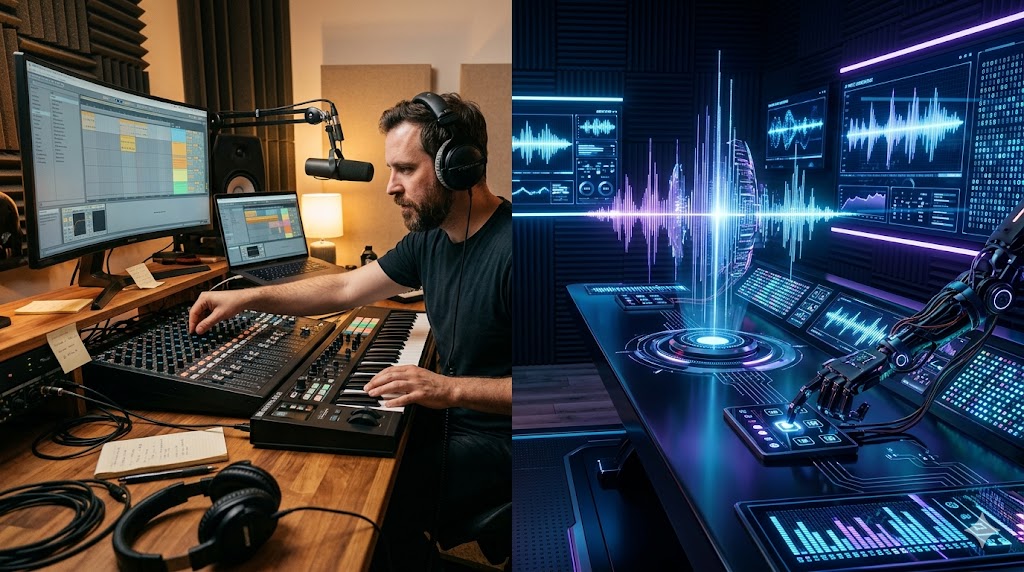
The debate over whether artificial intelligence (AI) could eventually replace music producers intensified after Nigerian disc jockey and producer DJ Neptune warned that the technology might soon “retire” producers. His remarks quickly sparked widespread conversation across Nigeria’s entertainment industry.
Reports indicate that the DJ recounted listening to a track he described as “out of this world,” only to later discover it had been entirely generated by AI. The revelation, he suggested, heightened concerns about the future role of human producers in music creation.
His comments come as AI-powered tools continue to evolve rapidly, allowing users to generate beats, melodies, lyrics, and even complete songs within seconds. This growing capability has raised fresh questions about automation and job security in creative industries.
According to The Business Research Company, the global market for artificial intelligence in music is expanding at a fast pace, with projections showing growth from about $4.48 billion in 2025 to roughly $5.55 billion in 2026. The increase reflects accelerating adoption of AI-driven music tools.
Similarly, data compiled by Musicful suggests that the broader AI music sector could grow into tens of billions of dollars over the next decade, fueled by rising demand for automated composition, mixing, and content creation technologies.
In addition, a study cited by Ari’s Take found that as many as 87 percent of music producers already use AI-powered tools in some form, underscoring how deeply the technology has entered modern production workflows.
Despite these developments, interviews with industry practitioners suggest that while AI is reshaping music production, it is unlikely to replace human creativity.
Sound producer and artiste Chinazor Francis Munonye, popularly known as Ice Berry, said he would still prefer working with human producers, noting that emotional depth cannot be automated.
“I would still prefer a human producer because AI cannot give you exactly what you’re feeling inside. Production means bringing into life what you feel from within, and that vibe is something only a human can truly create,” he said.
He acknowledged that AI could affect some jobs but insisted it would not diminish musical quality.
“AI is going to take away some people’s jobs as producers, but it will not reduce the quality of music. Human beings are naturally creative, and that cannot be compared,” he added.
Similarly, Jos-based producer Gabriel Mworina, also known as Mayor of Jos, described AI as more of a disruption than a direct threat.
“AI isn’t a threat to music production, but it is a disruption. And how big that disruption becomes depends on how producers and artists respond,” he explained.
He noted that while AI can generate beats quickly, it still struggles with cultural storytelling and originality.
“Music isn’t just about sounds — it’s about taste, emotion, culture, and originality. AI can copy styles, but it doesn’t live experiences or create movements,” he said.
Mworina warned that producers who try to compete with AI purely on speed risk being replaced.
“If a producer tries to compete with AI at speed and volume, they’ll lose. The winning move is to do what AI can’t and use AI for everything else,” he added.
Technology expert Joshua A. Maton said AI tools are already capable of handling many technical production tasks but still rely heavily on human direction.
“AI can create full songs, handle mixing and mastering, and generate melodies, but it cannot replace human creativity,” the expert said.
He explained that AI lacks emotions, lived experiences, and artistic judgment — qualities that remain central to meaningful music production.
According to Yapsody, AI is increasingly used for repetitive technical tasks such as mastering, tuning, and sound design, allowing producers to focus more on creative direction.
Meanwhile, figures from the International Federation of the Phonographic Industry show that global recorded music revenues reached $31.7 billion in 2025, supported partly by technological innovation, including AI-powered tools.
Industry observers note that the rise of AI mirrors earlier technological shifts, such as digital audio workstations and streaming platforms, which initially sparked fears but ultimately created new opportunities.
The emerging consensus among stakeholders is that AI will not eliminate producers but will redefine their roles, placing greater emphasis on originality, branding, and artist collaboration.
As the technology continues to evolve, the conversation may shift from whether AI will replace producers to how effectively producers can integrate it into their creative process — a transition many believe will determine who thrives in the next era of music production.