Two widely discussed commentaries—one drawing from Chinua Achebe’s literary masterpiece and the other questioning official electoral disclosures—have offered an early glimpse into the narratives that may shape Nigeria’s 2027 presidential election. Together, they suggest that the contest has already begun, not with campaign rallies, but in the battle for public perception, accountability and democratic legitimacy.
–
Political campaigns rarely begin with campaign posters or party conventions. They often start with ideas, narratives and questions that quietly seep into the national consciousness long before politicians officially declare their ambitions.
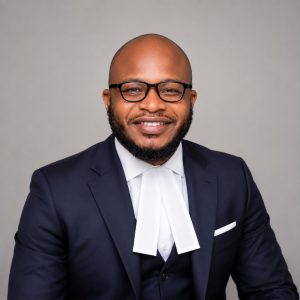
That was precisely my impression after reading two seemingly different but remarkably interconnected Facebook posts on the morning of August 3. Though approaching the subject from entirely different perspectives, journalist Udo Silas and former Minister of Youth and Sports Development, Comrade Solomon Dalung, appear to be speaking to the same underlying reality: the battle for Nigeria’s presidency in 2027 has already begun.
Udo Silas chose literature as his vehicle. In his thought-provoking essay, As Life Presidency Arrives Our Shores (2): Okonkwo and Amalinze—Understanding Tinubu’s Imagery of the Wrestler, he reaches into Chinua Achebe’s immortal Things Fall Apart to interpret President Bola Ahmed Tinubu’s recent declaration that he was prepared to “wrestle” his opponents to the finish.
For Udo, the metaphor extends beyond political rhetoric. He juxtaposes Tinubu’s imagery with Achebe’s legendary wrestling contest between Okonkwo and Amalinze the Cat, before drawing attention to the deeper tragedy that defined Okonkwo’s life—the killing of Ikemefuna despite the solemn warning of the elders.
His central message is unmistakable. Wrestling has rules. It has boundaries. It has impartial witnesses. Above all, it has an end.
Politics in a democracy, he suggests, should be no different.
The warning embedded in Achebe’s story is that strength without restraint eventually becomes self-destructive. Leaders who mistake power for destiny often ignore wise counsel, only to discover too late that victory secured at the expense of justice carries the seeds of eventual defeat.
Udo’s conclusion is as poetic as it is sobering: Nigeria itself has become Amalinze the Cat—a nation that has survived successive administrations without being completely subdued. The question now is whether the country’s democratic institutions will continue to uphold the rules of the contest or allow the arena itself to be captured.
Almost as if providing a constitutional footnote to Udo’s literary meditation, Solomon Dalung’s intervention moves the conversation from symbolism to accountability.
Reacting to the published particulars of presidential candidates reportedly released by the Independent National Electoral Commission (INEC), Dalung notes that President Tinubu allegedly left blank the sections relating to his primary and secondary school qualifications while listing only his university degree.
Dalung is careful not to make an accusation. Instead, he asks a question that goes to the heart of democratic governance.
Why were those sections left blank?
Whether one agrees with the premise or not, Dalung’s larger argument transcends educational qualifications. His concern is consistency.
If public officials insist that declarations, affidavits and official records are critical in assessing political opponents, then the same standard, he argues, must apply to everyone—including the incumbent president.
His point is neither sensational nor partisan. It is rooted in a principle fundamental to democracy: accountability cannot be selective.
Public trust flourishes where transparency exists. It withers where legitimate questions are dismissed as hostility or disloyalty.
Viewed separately, Udo’s essay and Dalung’s commentary explore different subjects. Read together, however, they reveal two dimensions of the same national conversation.
One interrogates the philosophy of power.
The other interrogates the exercise of power.
One warns against the temptation to confuse political dominance with democratic legitimacy.
The other reminds those in authority that public office carries with it an enduring obligation to answer public questions.
Both are, in essence, cautioning against the erosion of democratic norms.
The significance of these interventions lies not necessarily in whether one agrees with every conclusion they draw. Rather, it lies in the fact that they reflect issues already occupying the minds of politically conscious Nigerians months before formal campaigns begin.
The conversation surrounding 2027 is no longer simply about who will contest the presidency. It is increasingly about the character of the electoral process itself.
Will institutions remain independent?
Will transparency prevail over secrecy?
Will political competition be governed by established rules rather than overwhelming state power?
Will criticism continue to be accepted as a legitimate component of democratic discourse rather than portrayed as an act of disloyalty?
These are questions that will shape not only the election but also the credibility of its outcome.
Interestingly, beneath Udo’s post was a striking political cartoon depicting President Tinubu in a wrestling ring facing two prominent opposition figures—Atiku Abubakar of the African Democratic Congress (ADC) and Peter Obi of the Nigerian Democratic Congress (NDC) —while ordinary Nigerians, alongside armed security personnel, looked on with a mixture of anticipation and anxiety.
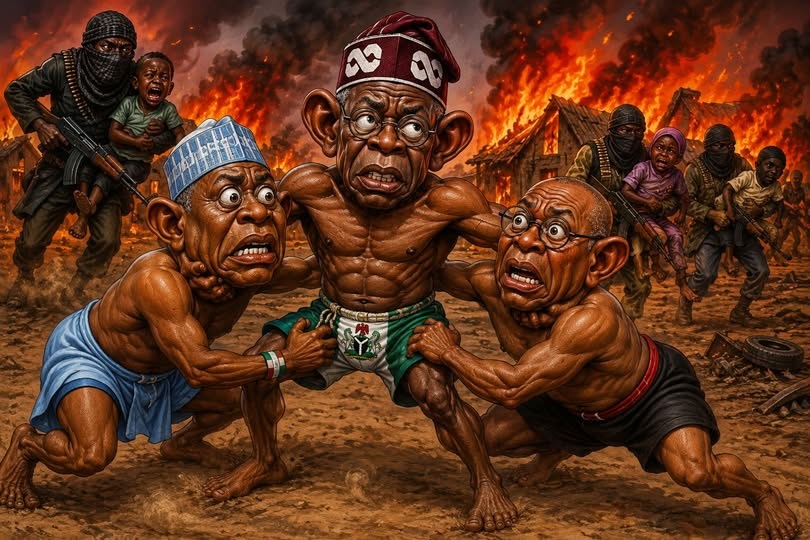
Whether intentionally or not, the image captures the national mood.
The spectators are not merely watching contestants.
They are watching the referee.
They are watching the rules.
They are watching the integrity of the arena itself.
History teaches that democracies are seldom weakened overnight. They are gradually diminished when institutions lose public confidence, when transparency gives way to ambiguity, and when the rules appear to favour one contestant over another.
That is why the reflections of Udo Silas and Solomon Dalung deserve thoughtful engagement rather than partisan dismissal.
One speaks through the timeless wisdom of Achebe.
The other through the language of constitutional accountability.
Together, they remind Nigerians that elections are not won merely by defeating opponents. They derive legitimacy from public confidence that the contest has been conducted fairly, openly and according to the rules.
The drums of 2027 are already echoing across the political landscape. Whether they herald another vigorous democratic contest or a bruising struggle over the soul of Nigeria’s democracy will depend not only on those seeking power, but also on the strength of the institutions entrusted with protecting the people’s mandate.