By CHRISTIANA LOT, Jos –
Alumni Association of the National Institute (AANI) has renewed its commitment to national development and security reform, advocating for a comprehensive, whole-of-nation strategy to address Nigeria’s socio-economic and security challenges.
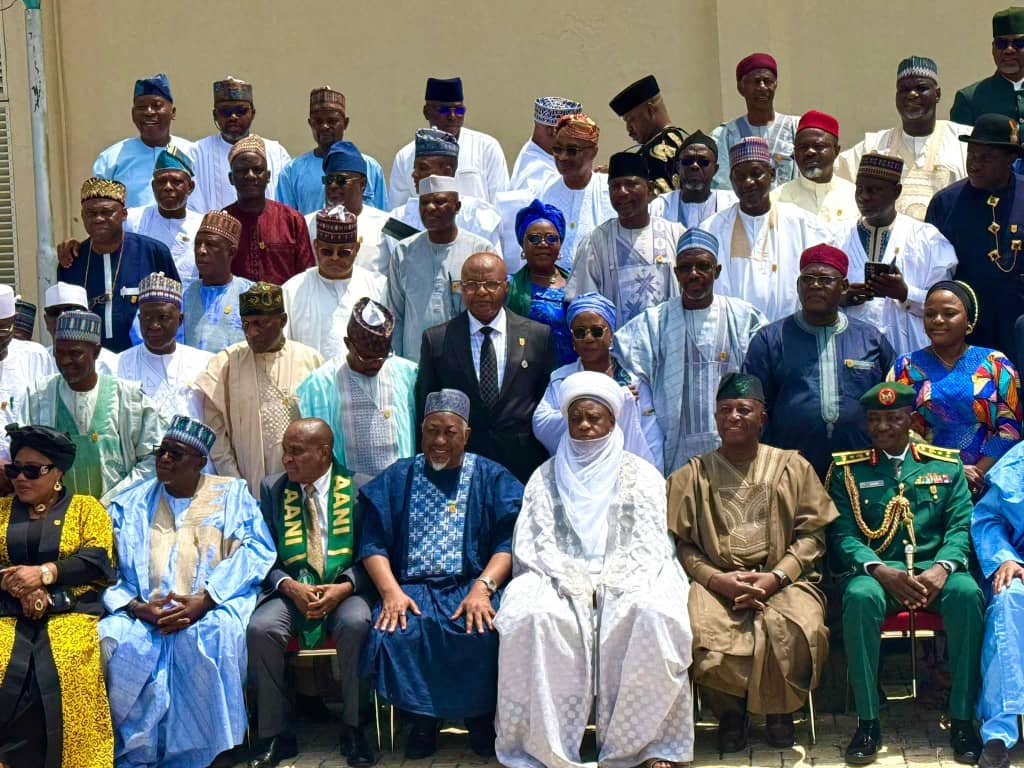
This resolution was adopted during AANI’s 45th Annual General Meeting, held on Saturday at the National Institute for Policy and Strategic Studies (NIPSS) in Kuru, Jos.
The gathering brought together policymakers, security chiefs, technocrats, and public servants to reflect on pressing national issues and discuss the Institute’s role in shaping sustainable solutions.
In his address, the Chairman of the occasion and Minister of Defence, Muhammad Badaru Abubakar CON, mni, outlined the military’s progress in countering terrorist networks and restoring order in troubled regions.
“We have dismantled major terrorist and bandit networks, neutralised hundreds of operatives, including their top leaders, and are witnessing a gradual return of internally displaced persons to their communities,” he said. “But the task of securing our nation cannot rest solely on the Armed Forces. It is a shared responsibility.”
He emphasized the importance of a national approach, where government, civil society, traditional leaders, and the private sector must all collaborate for sustainable security.
In a goodwill message, the Sultan of Sokoto and Chairman of AANI’s Heritage Council, His Eminence Alhaji Muhammad Sa’ad Abubakar III, CFR, mni, expressed concern over Nigeria’s stagnation despite the high calibre of professionals trained at NIPSS.
He stressed the need for government and leaders to take the Institute’s work seriously, noting that the country’s challenges would persist if key recommendations continue to be ignored.
Delivering the keynote lecture, Professor Okey Ikechukwu, mni, Executive Director of Development Specs Academy, attributed Nigeria’s leadership crisis to a breakdown in national values and identity.
“Our greatest national resource is not oil or minerals—it is the Nigerian citizen. But have we truly raised citizens, or merely produced people?” he asked. “Until we invest in values, discipline, and leadership grounded in public interest, we will keep lamenting.”
He argued that the root of Nigeria’s issues lies not in a lack of policies, but in poor implementation and neglect of human development. He called for a national civic values program, greater youth engagement through ministry collaboration, and increased citizen oversight in governance.
“We need to restore trust between the state and citizens and revive moral leadership from the grassroots up,” he added. “If we want a reborn nation, we must reinvent the values and integrity of the Nigerian state.”
Earlier, AANI President, Ambassador Emmanuel Obi Okafor, mni, reaffirmed the association’s commitment to providing strategic leadership, despite the economic constraints affecting member participation.
“AANI, as a reservoir of expertise and patriotism, must continue to offer innovative policy solutions to Nigeria’s pressing issues. Our motto—Towards a Better Society—is not just a slogan; it is a national call to service.”
In his remarks, the Secretary to the Government of Plateau State, Arch. Samuel Jatau, who represented Governor Caleb Mutfwang, commended NIPSS and AANI for their contributions to national development and underscored the importance of fostering national unity and trust as part of rebuilding efforts.
The AGM concluded with a unified call for inclusive leadership, patriotic citizenship, and value-driven governance as vital pillars for Nigeria’s rebirth.