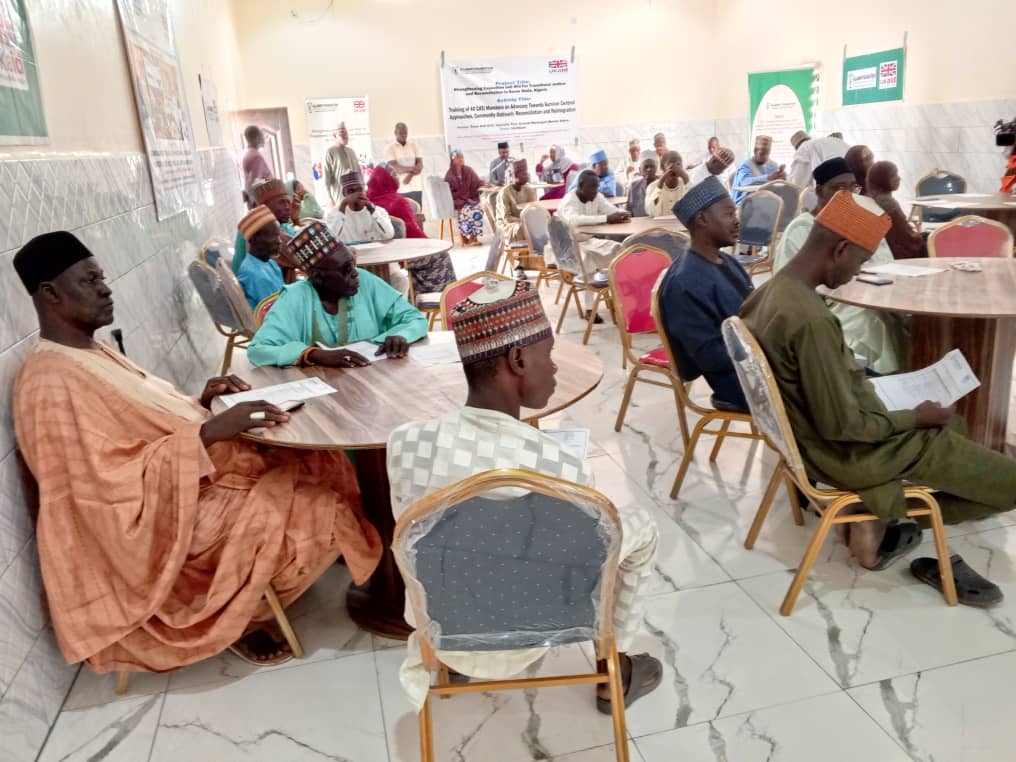
A cross section of stakeholders at the meeting in Maiduguri
By SADIQ ABUBAKAR, Maiduguri –
The Allamin Foundation for Peace and Development, based in Maiduguri, Borno State, organized a one-day training workshop for 40 Community Advocates for Transitional Justice (CATJ) selected from four Local Government Areas (LGAs) in Borno State.
The workshop was organized for selected CATJ members from four LGAs: Maiduguri Metropolitan Council (MMC), Jere, Konduga, and Mafa
The workshop aimed to broaden participants’ knowledge on survivor-centered approaches towards reconciliation and reintegration.
The Facilitator and Monitoring & Evaluation Consultant of Allamin Foundation, Dr. Lawan Balami, introduced the topic of discussion and emphasized the importance of gathering meaningful opinions and recommendations from the CATJ participants.
He said the workshop aimed to identify and address critical challenges and problems faced by survivors and victims of conflict.
Dr. Balami added that the workshop sought to strengthen their capacities and will for transitional justice and reconciliation in Borno State, Nigeria, in line with the project activity supported by the Foreign Commonwealth Development Office (FCDO).
The workshop covered topics such as survivor-centered approaches, identifying different groups of survivors, developing targeted advocacy messages, and identifying survivor needs. Group work and presentations were also conducted, focusing on who is a survivor, introduction to survivor-centered approaches, and identifying target stakeholders for advocacy.
Some community stakeholders suggested government interventions on poverty alleviation, security provision, farmland and agricultural implements, seeds and seedlings, fertilizers, youths and women empowerment, and skills acquisition training. Participants also recommended social cohesion, economic empowerment support, education support, health facilities and amenities support, transportation support, housing support for IDPs, livelihood support, and training on awareness creation, advocacy, mediation, psychosocial support, protection from violence, and social integration.
The interpreter and Consultant, Barrister Mohammed Umar Esq, elaborated on the reasons for the workshop, its aims and objectives, procedures for deliberations, expected outcomes, challenges, and constraints.