Senior lawmakers and development stakeholders on Saturday called for an urgent, coordinated economic rescue of the North West, warning that decades of fragmented development efforts have deepened poverty, insecurity and underdevelopment in the region.
The call was made at the North West Development Summit held at the Yar’Adua Conference Centre, Kaduna, with the theme “Advancing a Coordinated Regional Development for North West Nigeria.”
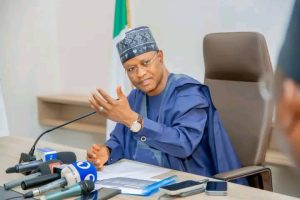
Speaking at the summit, Deputy President of the Senate, Senator Barau I. Jibrin, said the region’s major challenge was not lack of resources but absence of coordination in policy, planning and implementation across states.
Barau said the establishment of the North West Development Commission (NWDC) was a deliberate response to years of disjointed interventions that failed to deliver sustainable development.
He noted that despite being Nigeria’s largest agricultural zone and home to millions of citizens, the North West continues to grapple with insecurity, infrastructure deficits, youth unemployment, climate challenges and weak access to social services.
“These challenges do not respect state boundaries; therefore, our solutions must rise above them,” he said.
Barau assured that the National Assembly would provide the necessary legislative support and oversight to ensure the success of the NWDC in line with President Bola Tinubu’s Renewed Hope Agenda.
He urged stakeholders to move beyond rhetoric and focus on building systems that would deliver tangible benefits to citizens, stressing that leadership would ultimately be judged by outcomes.
In his welcome address, Chairman of the Senate Committee on the NWDC, Senator Babangida Hussaini, described the North West as a region that once powered Nigeria’s economy through agriculture and manufacturing but is now burdened by poverty and unemployment.
Hussaini said although the region contributes over 40 per cent of Nigeria’s agricultural output and hosts some of West Africa’s largest markets, it ranks among the highest in poverty levels and out-of-school children statistics.
He attributed the decline to development pursued in silos, resulting in duplication of projects without scale or lasting impact.
According to him, insecurity alone costs the region billions of naira annually through disrupted farming, lost productivity and capital flight.
Hussaini said the creation of the NWDC and the Ministry of Regional Development marked a reset, recognising that regional challenges require coordinated regional solutions.
He identified four priority pillars for recovery: security and stability; infrastructure and connectivity; agriculture and industrial value addition; and human capital development.
“No economy grows where farmers cannot farm and traders cannot trade,” he said, calling for investment in transport corridors, power, irrigation, storage facilities and broadband infrastructure.
He added that processing agricultural produce such as grains, tomatoes, cotton, hides and livestock within the region could generate massive employment and expand the regional economy.
Chairman of the occasion and former Vice President, Arch. Mohammed Namadi Sambo, stressed that the NWDC must translate policies into measurable impact in the lives of citizens.
Sambo said the Act establishing the Commission provides a framework for coordinated infrastructure development, economic growth, social transformation and environmental sustainability.
He cited abandoned power projects in Kaduna, including a 250-megawatt thermal plant and a 30MW Gurara hydropower facility left idle for over a decade, as examples of poor coordination.
He also referenced a long-delayed multi-purpose dam expected to generate 40MW of electricity, irrigate 35,000 hectares and supply water to Kaduna metropolis, urging that such projects be unlocked.
The former Vice President called for partnerships with private investors, development partners and power agencies to revive stalled assets and expand renewable energy across the region.
Speakers at the summit agreed that revitalising the North West was not a regional favour but a national economic necessity, urging stakeholders to ensure that coordination translates into visible development outcomes.