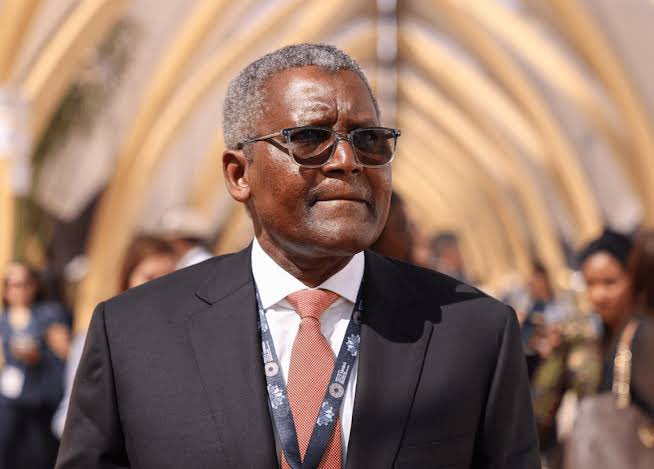
Aliko Dangote
President of Dangote Group, Alhaji Aliko Dangote, has accused international traders of deliberately undermining Africa’s refining industry by maintaining an offshore Lomé floating market, which he claims is designed to stifle local refinery operations.
Speaking at the inaugural Global Community Insights Conference on West African Refined Fuel in Abuja, organized by the Nigerian Midstream and Downstream Petroleum Regulatory Authority (NMDPRA) and S&P Global Commodity Insights, Dangote highlighted the challenges facing the continent’s refining sector.
Delivering a presentation titled “ _Building an African Refinery Hub: Prospects and Challenges,”_ Dangote revealed that the Lomé floating market, holding over two million tonnes of petroleum products offshore, sells fuel at inflated prices to African nations due to limited local refining capacity.
“The sole purpose of the Lomé market is to ensure no refinery thrives in Sub-Saharan Africa,” he said.
“When Dangote Refinery became operational, these traders crashed prices to counter our efforts, but those profiting from this system will fiercely resist any new refineries.”
Dangote pointed out that the lack of local refining capacity allows traders to dump cheap, often substandard petroleum products in Africa, blended with discounted Russian crude under price caps.
“These low-quality fuels, unacceptable in Europe or North America, undercut local production, which relies on full-market crude pricing,” he explained.
He urged African governments to dismantle these barriers through policy alignment, regional cooperation, and strong political will.
Drawing parallels with the cement industry, Dangote highlighted Nigeria’s transformation from producing two million tonnes annually to over 50 million tonnes, making it a net exporter.
“By mid-2026, our cement capacity across Africa will reach 60 million tonnes, with Nigeria targeting $500 million in cement and clinker exports by 2027,” he said.
He vowed to replicate this success in energy, noting that Nigeria has become a net exporter of refined petroleum products, polypropylene, and urea.
“Our refinery produces 2,500 tonnes of LPG daily, encouraging more households to adopt LPG. Soon, we’ll list the refinery, allowing Nigerians to become shareholders,” Dangote added.
He stressed the need for Africa to refine its own petroleum products locally to achieve energy self-sufficiency.
The conference, aimed at fostering a West African refined fuel market, focused on regional standardization, pricing transparency, stakeholder collaboration, and expanding refining and infrastructure capacity.