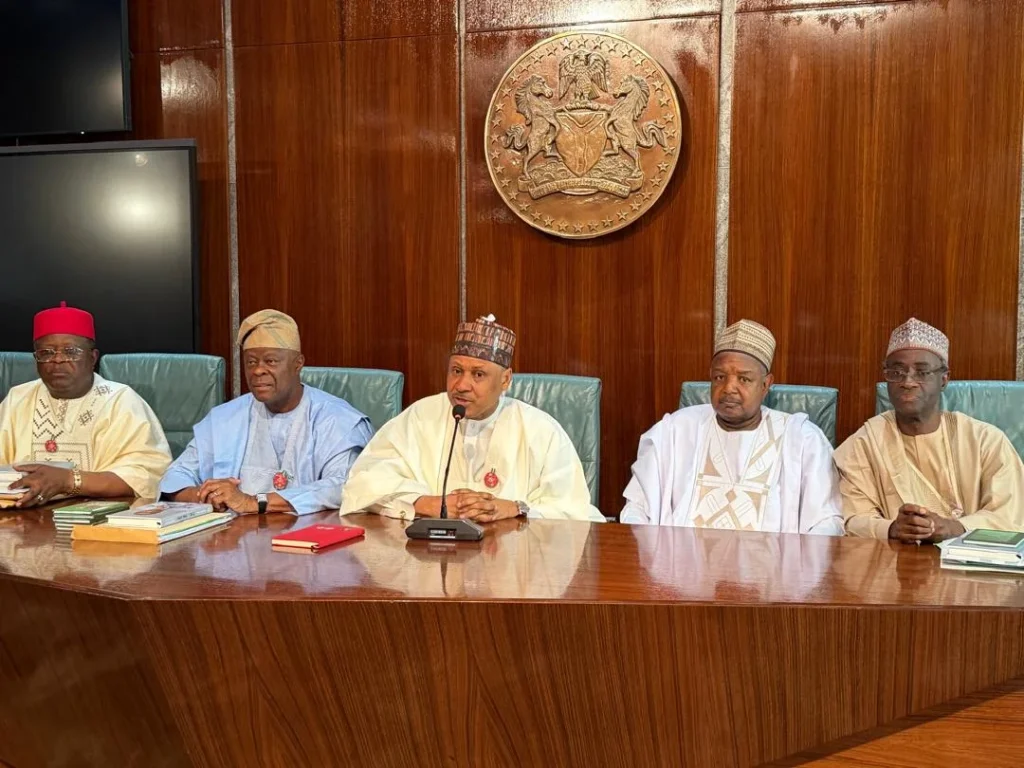
Federal Executive Council (FEC) has approved a ₦58.47 trillion budget proposal for the 2026 fiscal year, setting the stage for its presentation to the National Assembly by President Bola Tinubu.
The approval was announced on Friday by the Director-General of the Budget Office of the Federation, Mr. Tanimu Yakubu, while briefing journalists after the council meeting at the Presidential Villa, Abuja.
According to Yakubu, the budget was considered alongside the 2026–2028 Medium-Term Expenditure Framework (MTEF) and Fiscal Strategy Paper (FSP), which put the total size of the framework at ₦54.46 trillion, with retained revenue estimated at ₦34.33 trillion.
He explained that the proposed 2026 budget represents a six per cent increase over the 2025 budget estimate, reflecting adjustments in key spending obligations.
“This includes projected spending of government-owned enterprises amounting to ₦4.98 trillion, and ₦1.37 trillion for grants and donor-funded projects,” Yakubu said.
He added that aggregate expenditure also covers statutory transfers of ₦4.1 trillion and debt service obligations totaling ₦15.52 trillion, which include ₦3.388.54 billion earmarked for the sinking fund to retire maturing issues owed to local contractors and creditors.
Breaking down other major components, Yakubu said personnel costs, including pensions, are projected at ₦10.75 trillion.
“This includes ₦1.02 trillion for government-owned enterprises and is seven per cent higher than the 2025 provision, while overhead costs stand at ₦2.22 trillion,” he stated.
The budget, according to the Director-General, was carefully structured to strike a balance between economic stability and development priorities within the medium-term fiscal framework.
“The 2026 budget reflects a deliberate balance between macroeconomic stabilisation, development imperatives and the medium-term fiscal framework,” Yakubu said.
He noted that the assumptions underpinning the budget are “conservative and realistic,” particularly in relation to oil prices, exchange rates and expected dividends from government-owned enterprises.
While revenues are projected to decline year-on-year, Yakubu highlighted a notable shift in Nigeria’s revenue structure.
“Non-oil revenues now account for roughly two-thirds of total receipts, confirming a structural shift away from oil dependence,” he said.
He added that corporate income tax, value-added tax (VAT), customs duties and independent revenues remain the main fiscal anchors, while expenditure growth is largely driven by debt servicing, wages and pensions rather than new discretionary spending.
“Capital spending is marginally reduced to prioritise completion of ongoing projects and value for money. The larger deficit reflects realities rather than policy loosening. Financing relies on domestic borrowing, complemented by concessional multilateral loans,” Yakubu explained.
Earlier, the Minister of Budget and Economic Planning, Senator Abubakar Bagudu, confirmed that the council approved both the 2026 budget proposal and amendments to the medium-term framework.
“As well as an amendment to the medium-term expenditure framework, which we propose, a revision downwards of the exchange rate from ₦1,512 to ₦1,400 and the consequential changes in budget size,” Bagudu said.
“So, the Federal Executive Council approved both the amendment to the medium term as well as the 2026 budget proposal for presentation to the National Assembly,” he added.
Also speaking, the Minister of Information and National Orientation, Alhaji Mohammed Idris, said the FEC meeting was convened specifically to deliberate on the 2026 budget.
“The budget has been looked at and discussed by members of the FEC after its due presentation by the Minister of Budget and Economic Planning and the Director-General of the Budget Office,” Idris said.
The approved proposal will now be transmitted to the National Assembly for legislative consideration.
NAN