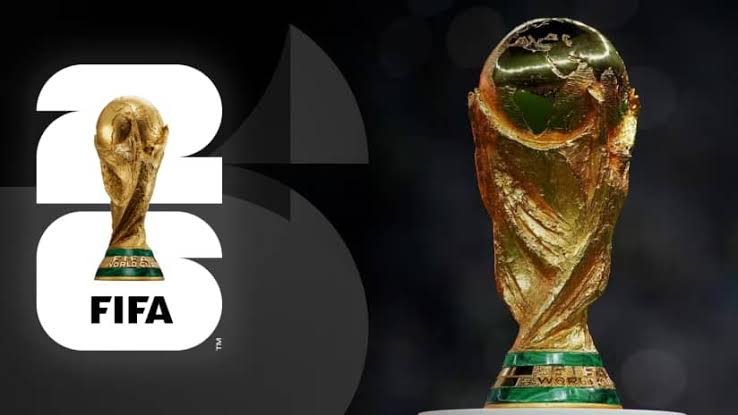
FIFA 2026 World Cup
When the FIFA World Cup finals kick off on June 11, Nigeria’s presence will be felt, but not as a competitor. Nigerian musician, Burna Boy, will headline the opening ceremony in a duet with Colombian superstar, Shakira, who will be performing at the opening of the global football fiesta for the second time. Her first was at the 2010 edition in South Africa.
Despite their challenging trade and diplomatic relations, Canada, Mexico, and the United States will jointly host the competition. This will be only the second time in its history that the World Cup tournament will be shared among joint hosts after South Korea and Japan did so in 2002.
This year’s tournament comes at a time of profound uncertainty and serious questions about the future of international peace and security. It could also be a showcase for coexistence in a time of global fragility.
To be sure, awkward political and diplomatic subtexts have never been far from the World Cup tournaments. Uruguay hosted the first edition in 1930 at the onset of the Great Depression. Underscoring an anti-colonial subtext, Montevideo’s Estadio Centenario, venue of the final match, was built to commemorate 100 years of Uruguay’s independence from Spain in 1830. Spain kept away.
Thirteen countries participated in that inaugural edition. Uruguay subsidized the costs of travel and accommodation, which ultimately enabled four European countries to participate: Belgium, France, Romania, and Yugoslavia.
Italy hosted the tournament in 1934, and its ruler, Benito Mussolini, turned it into a prop for fascist iconography. Political machinations on and off the field enabled Italy’s emergence as the eventual winners. It was the beginning of an Italian spring in world football.
Two years later, Italy was again ascendant, beating Austria to the gold medal at Adolf Hitler’s Olympics in Berlin in 1936.
By the time the third edition of the World Cup tournament turned up in France on June 4 1938, Austria, one of the favourites for the title, was no longer in existence. Three months earlier, on March 12 – one day after the abdication of Kurt von Schuschnigg as Austria’s Chancellor – Hitler’s troops crossed the German border and the Anschluss was underway.
Austria’s annexation was formally pronounced the next day, and Hitler turned up in Vienna, the capital of Austria, to celebrate it two days later on March 15.
Italy’s triumph at the final game on June 19 1938, was the first time a defending champion would retain the World Cup. It was also approaching a high point of Hitler’s Nationalsozialismus – National Socialism – and Mussolini’s fascism. Fourteen and a half months later, Germany invaded Poland to mark the beginning of World War II.
Racism was an early theme at the World Cup. Brazil’s Leônidas da Silva, the highest scorer at the 1938 tournament, was a Black whose skill and talent upset then prevalent notions of White supremacy. In his absence, Italy prevailed over Brazil in the semi-final amid suspicions that his exclusion from the match had been procured under pressure from the tournament administration.
The competition was to suffer an abeyance for the following 12 years. By the time it returned in 1950 in Brazil, Hitler and Mussolini had been defeated and decolonization had begun. India, less than three years as an independent country, was one of the qualifiers but withdrew shortly before the tournament began.
The 1978 World Cup tournament in Argentina was a propaganda victory for the host country’s military dictatorship. Located at the Navy Mechanical School in the capital city, Buenos Aires, the regime’s largest torture centre was within earshot of Estadio Monumental, venue of the final match, which Argentina won for the first time.
This year, despite ongoing conflict and an uncertain ceasefire between Iran and the U.S., FIFA has confirmed that Iran will compete in the tournament and will play all its three group stage matches inside the U.S. Iran is one of 48 countries that will compete in the tournament over 104 matches across 16 venues in the three host countries.
The opening match between Mexico and South Africa on June 11 will be one of five matches to be played at the Azteca Stadium, which hosted the coronation of Argentina’s Diego Maradona as the king of world football at the final match in 1986. Guadalajara and Monterrey, also in Mexico, will host four matches each. Thirteen matches will be played in Canada, seven in Vancouver and six in Toronto.
The MetLife Stadium in East Rutherford, New Jersey, will host the final game, as one of 11 venues for the 78 games to be played in the U.S. Other U.S. venues include Atlanta, Boston, Dallas, Houston, Kansas City, Los Angeles, Miami, Philadelphia, the San Francisco Bay Area, and Seattle.
The Gillette Stadium in Foxborough, Massachusetts, will host seven matches, including a quarter-final on July 9. The countries scheduled to compete in the group matches at Gillette Stadium, or Boston Stadium, as it will be known during the tournament, include England, France, Ghana, Haiti, Iraq, Morocco, Norway, and Scotland.
Despite widespread concerns about the effects of current U.S. immigration policies, many of these countries share rich histories with the New England area, which could make for intriguing contests and guarantee enthusiastic fan interest.
For much of its history, the World Cup was in fact a contest between European and Latin American countries. Decolonization changed this. The result is expansion from 13 countries at the inception to 48, competing this summer. Over the years, decolonization has remained a durable subtext of the competition, and is likely to be true of the 2026 tournament.
The first match at Boston Stadium will be on June 13 between Haiti and Scotland. For Haiti, the site of the first successful slave revolt in the world and a country affected by current U.S. immigration restrictions, there is evocative irony to the fact that it will play its first-ever World Cup match in the Boston area, once a hub in the transatlantic slave trade. Similarly, Scotland and Boston share a storied history dating back to the earliest Scottish prisoners of war, who were banished to the Boston Bay colony during the rule of Oliver Cromwell and Charles II in the mid-17th century. The Scots Charitable Society, founded in 1657 in Massachusetts to help those in need after they completed their forced indentured servitude, is reputed to be the oldest charitable organization in the western hemisphere.
Three days later, on June 16, the MetLife Stadium in New Jersey will host the second post-colonial derby at the World Cup between France and Senegal. When both teams met at the opening game of the 2002 World Cup, Senegal ran away as a shock but deserving victor. This time, the African country will likely enjoy significant support from the substantial population of Senegalese origin in the New York-New Jersey neighbourhood.
The contest between England’s Three Lions and former colonial subjects, Ghana’s Black Stars, on June 23 could similarly inspire the absorbing passions of a post-colonial derby in a competition that will have a few more. When Spain turns up three days later to take on Uruguay in Guadalajara, Mexico, on June 26, it will be a re-enactment of their original post-colonial narrative at the maiden World Cup tournament.
This absorbing interplay of history, memory, identity, skill, athletic ability, and entertainment is why the FIFA foremost football fiesta continues to evoke passion on a scale unknown to any other single sporting event. Whether this year’s tournament will leave any lasting legacies on the major questions facing our world today will be debated long after a winner is settled on July 19. Meanwhile, for over 39 days, the world can at least take a break.
_A lawyer and a teacher, Odinkalu can be reached at chidi.odinkalu@tufts.edu_