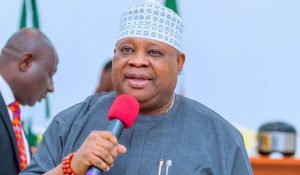
Benue State Governor, Hyacinth Alia
By TYAV SAM TYAV, Makurdi –
The Benue State Governor, Hyacinth Alia has expressed his readiness to increase the already existing bond between the government and the office of the United Nations High Commissioner for Refugees (UNHCR), with the aim of tackling the humanitarian crises in the state.
Governor Alia disclosed this on Thursday while receiving the UNHCR delegation in Makurdi.
To this end, the Governor reiterated his administration’s resolute stand and determination to continue to address the needs of the IDPs, commending UN for mobilizing resources for the IDPs and refugees in the state and country, and for also setting up offices for UNHCR and the International Organization for Migration (IOM), in Benue state
A statement by the Chief Press Secretary to the Governor, Tersoo Kula quoted the governor as appreciating the UNHCR for mobilizing resources for refugees and the Internally Displaced Persons (IDPs), saying their plight is a matter of urgent concern to his administration.
According to the statement, the governor, who regretted the security challenges in Benue, reassured of his administration’s resolve to continue to work together with the security agencies to ensure the safety of everyone living in the state and to restore the lives and livelihoods along the Makurdi to Kadarko routes, the deep fields in Guma, Kwande, Gwer, Agatu and Logo LGAs, where displacement and insecurity have severely impacted.
Highlighting some of the steps taken by his government to support the humanitarian efforts in the state, the governor said aside from the establishment of the Ministry of Humanitarian Affairs and Disaster Management and the strengthening of the SEMA office, the Bureau of International Cooperation and Development (BICD) was also set up to serve as a gateway agency for donor relations and resource mobilization for MDAs.
He announced the donation of the old Ministry of Information building along Barracks road, as a central hub for UN activities in the state; the allocation of farmlands for the IDPs and Cameroonian refugees in Ikyogen to enable them to go into farming; the allocation of vendor assignment from MDAs to the IDPs to aide their integration into the society; establishment of cooperatives to enable the IDPs to engage in income-generating activities, as well as the setting up of IDPs farms meant to carter for their feeding needs, as some of the initiatives put in place by the government to help the plight of the displaced persons in the state.
The governor, who appreciated the Bola Ahmed Tinubu-led Federal Government for their support to ensure the return of the IDPs to their ancestral homes, intimated the delegation of the proposed 3,000 housing units which will provide shelter and vital services to at least 16,000 forcibly displaced persons, adding that each compound will be complemented by essential infrastructure such as good roads, hospitals, markets, good water provision among others.
He promised close collaboration between the government and donor agencies for the IDPs in the state, saying his administration would always ensure that anybody who calls Benue home thrives.
The leader of the UNHCR delegation and the UNHCR Assistant High Commissioner for Operations, Mr. Raouf Mazou appreciated the government of Benue State for her efforts in responding to the humanitarian crisis in the state and for providing shelter for the Cameroonian refugees at Ikyogen, in Kwande local government area and assured that the UNHCR would continue to be supportive in helping the state in its response to the humanitarian crisis.
The German Ambassador to Nigeria, Ambassador Annett Günther, in her remarks said she was happy to be on the delegation because the governor has shown concern for the IDPs through his support for the Durable Solution initiative, and most importantly, for the good leadership qualities he has demonstrated in office so far.
Günther called for continued collaboration from all stakeholders involved to ensure the IDPs and refugees enjoy a better life.
Also on the delegation were UNHCR Assistant High Commissioner for Protection, Ruvendrini Menikdiwela; the UNHCR Regional Director for West and Central Africa, Abdouraouf Gnon-Konde, amongst many others.