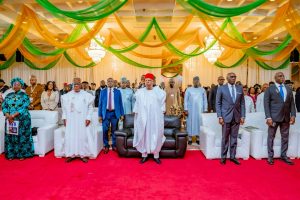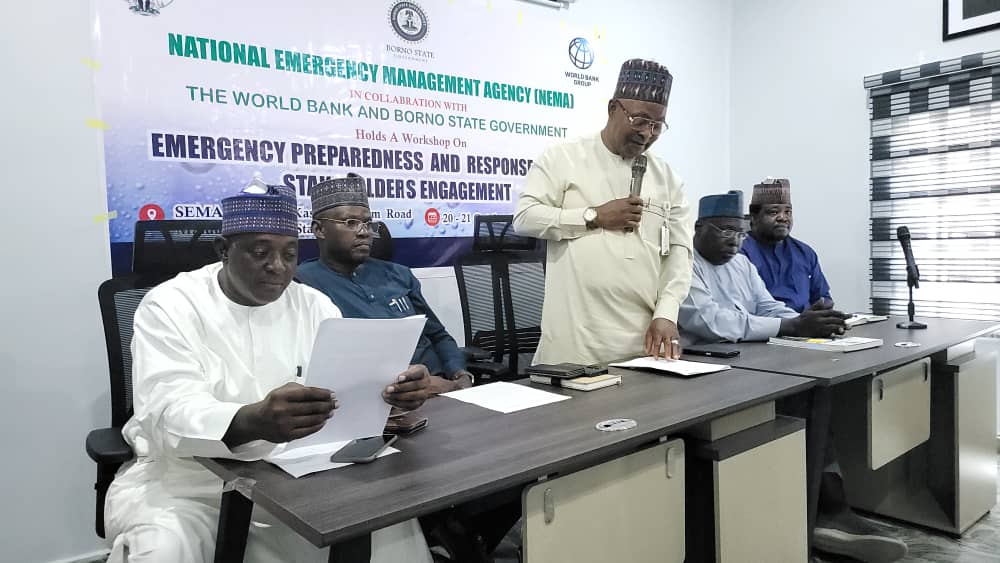
National Emergency Management Agency (NEMA) in partnership with the World Bank Group and the Borno State Emergency Management Agency, SEMA on Monday held a stakeholders Engagement on Emergency Preparedness and Response (EP&R) in Maiduguri the State capital.
The event, which is aimed at boosting disaster management capacity in Borno, was led by the Director General of NEMA, Mrs. Zubaida Umar, who was represented by the Director of Planning, Research and Forecasting at the Agency, Dr. Bandele Onimode.
Reading Mrs. Umar’s remarks, Onimode welcomed all participants to the 2-day Emergency Preparedness and Response (EP&R) stakeholders’ engagement workshop in Borno, as it is one of the pilot locations under the ongoing NEMA–World Bank collaboration designed to strengthen Nigeria’s sub-national emergency management architecture.
“This engagement is part of a continuing series that has already taken us through Kogi, Delta, Ondo, Kano, and Kebbi states, where we have worked closely with State Emergency Management Agencies, local authorities, and community actors to build the foundation for stronger, faster, and more coordinated response systems.
“Each of these states has contributed invaluable insights from Kogi and Delta’s lessons on flood risk coordination, to Ondo’s experience in community-driven preparedness, and the capacity-building initiatives advanced in Kano and Kebbi.
“Through these engagements, we have seen how shared commitment and local leadership can translate into tangible improvements not just in readiness, but in the overall resilience of our people.
“Today, as we convene in Borno State, we continue that momentum with renewed purpose. Borno presents a unique landscape, one marked by resilience, recovery, and the determination to rebuild stronger. While the State faces recurrent flood threats and other natural hazards, it has also shown how communities, when empowered and well-coordinated, can become the strongest link in the disaster management chain”, She said.
Umar also stressed that the EP&R project seeks to strengthen this foundation by: Establishing functional emergency preparedness and response structures across all local government areas; Developing a comprehensive database of trained volunteers; Advocating for the institutionalization and activation of Local Emergency Management Committees (LEMCs); and Enhancing disaster coordination, data management, and early warning capabilities at sub-national levels”.
Delivering a keynote address, the World Bank Representative, Dr. Oluwaseun Olowoporoku, who is an urban specialist, commend the Government of Borno State for its commitment to safeguarding lives, livelihoods, and infrastructure from the growing threats of climate and disaster risks.
“Today’s session marks a pivotal moment in advancing that commitment—bringing together stakeholders from across sectors to design practical, coordinated, and evidence-driven systems that can protect both people and development gains.
“Borno State, known for its agricultural prominence, huge trade potential, faces increasing vulnerability to floods, droughts, and related public health emergencies. Recent years have seen devastating flood events, including the unprecedented 2024 floods—that displaced thousands, submerged farmlands, disrupted economic activities, and strained public infrastructure.
“Climate projections for the Northeast region of Nigeria indicate rising temperatures, changing rainfall patterns, and greater hydrological variability, which could intensify flood and drought risks. For a state where agriculture underpins food security and livelihoods, these hazards threaten not only communities but also statewide economic stability and long-term development.
“This is why the World Bank, in collaboration with the Government of Borno State, is co-developing a robust, multi-hazard Emergency Preparedness and Response (EP&R) system. Our goal is to: Strengthen early warning capabilities…”, he said.