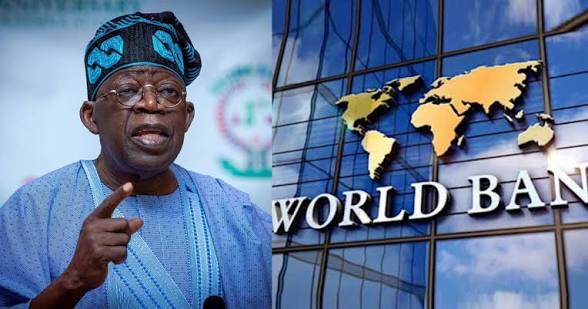
President Bola Tinubu and World Bank logo
Nigerians have taken to the World Bank’s official social media platforms especially Instagram and X (twitter) with comments to urge the lender to halt further approving new loans for President Bola Tinubu’s administration, citing rising debt and concerns over how borrowed funds are used.
The outpouring followed reports that the government is seeking a fresh $1.25 billion facility, titled ‘Nigeria Actions for Investment and Jobs Acceleration’, which is set for consideration by the World Bank board on June 26, 2026.
Under recent posts on the bank’s official social media accounts, Nigerian users urged the institution to withhold further financing. Many accused political leaders of mismanaging public funds while ordinary citizens face rising living costs.
“World bank abeg stop borrowing us Nigerians money again our greedy politicians are using it to enrich themselves at our detriment,” one comment read.
Others wrote, “Don’t borrow Tinubu money again they want to finish Nigerians ooh,” and “stop borrowing the president of Nigeria money…
Yet another supported the government saying borrowing to fund capital projects and improve the economy is the standard in modern economics especially for developing nations.”
Reactions come as Nigeria’s debt profile draws renewed public scrutiny. Data cited in the reports show the World Bank approved about $9.35 billion in loans and credits for Nigeria between June 2023 and May 2026, covering power, education, healthcare, agriculture, and economic reforms. Approval of the new facility would bring total commitments under Tinubu’s tenure to roughly $10.6 billion.
The proposed loan is intended to support economic reforms, investment growth, digital access, electricity expansion, and job creation.
Debt servicing remains a central concern. President Tinubu recently said Nigeria could spend about $11.6 billion on debt service in 2026, nearly half of projected revenue for the year. He made the remark while calling for reforms to the global financial system, arguing that African countries face less favorable borrowing terms than wealthier nations.
Since taking office in 2023, the administration has implemented major economic changes, including the removal of the fuel subsidy and the floating of the naira. The government maintains the measures are necessary for long-term stability, but for many Nigerians online, the scale of foreign borrowing continues to raise questions about future obligations and economic direction.
However, the online discourse quickly became polarised. While some users strongly opposed further external loans, others defended borrowing as a standard practice in global economics, especially for developing nations seeking infrastructure financing.
Meanwhile, as at the time of reporting, the World Bank has drawn attention online, reportedly blocking the comment section on one of its Instagram posts following a wave of criticisms from Nigerian users over the proposed loan.