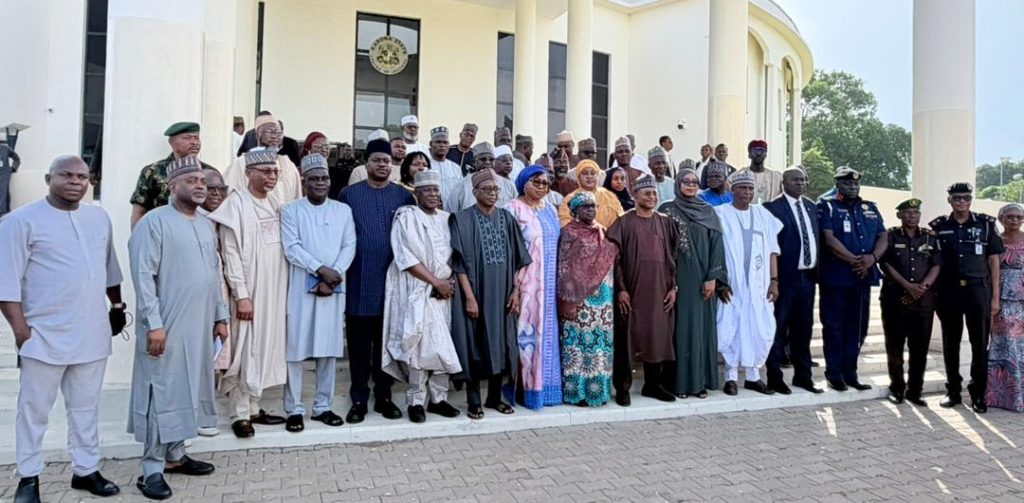
Kaduna State Governor, Uba Sani, has inaugurated a Disarmament, Demobilisation and Reintegration (DDR), Peace and Security Committee, pledging strong political backing to ensure its success in tackling insecurity and sustaining peace across the state.
The committee, whose framework was facilitated by the Office of the National Security Adviser and the National Counter Terrorism Centre, is the first of its kind at the subnational level in Nigeria.
Speaking at the inauguration, the governor recalled the grim security situation that once defined Kaduna, noting that banditry, kidnapping and other violent crimes had taken root across large parts of the state, crippling economic activities and instilling fear among residents.
He said major corridors such as the Kaduna–Abuja highway and the Birnin Gwari axis, once critical for movement and commerce, had become flashpoints of insecurity.
Sani explained that upon assumption of office, his administration adopted a multi-dimensional strategy to address the crisis, combining kinetic operations with non-kinetic measures aimed at addressing underlying causes of conflict.
He described the approach, now widely known as the Kaduna Peace Model, as one that recognises insecurity as a product of deeper socio-economic challenges including poverty, exclusion and lack of opportunities.
According to him, the government has strengthened collaboration with federal security agencies, improved operational capacity, and simultaneously invested in dialogue, community engagement and human development initiatives.
“As a result, normalcy is gradually returning, with safer highways and a revival of economic activities across previously troubled areas,” he said.
The governor stressed that lasting peace cannot be achieved through force alone, noting that dialogue remains a critical component of the state’s strategy.
He added that engagement with community leaders, traditional institutions and repentant actors has helped rebuild trust and foster reconciliation.
In her remarks, the Director of Preventing and Countering Violent Extremism at the National Counter Terrorism Centre, Ambassador Abimbola Wonosikou, described the inauguration as a significant step toward achieving sustainable peace and development.
She said the committee’s establishment followed extensive regional consultations across Nigeria’s six geo-political zones, conducted in collaboration with the UK Strengthening Peace and Resilience in Nigeria (UK-SPRiNG) programme.
Wonosikou explained that the consultations highlighted the need for coordinated DDR structures at both national and state levels, tailored to local realities while aligned with a broader national framework.
She noted that state-level committees are expected to serve as implementation units, translating policy into action on the ground.
According to her, the initiative is aimed at addressing the root causes of insecurity through disarmament, dismantling of violent networks and reintegration of affected individuals into society.
Earlier, the Technical Adviser on the National DDR Framework Development and Harmonisation Process, Dr Paul Nyulaku, commended the Kaduna State Government for its proactive approach, noting that the state is leading by example.
He emphasised the importance of dialogue in conflict resolution, describing the governor’s reconciliation efforts as nationally recognised, particularly in bridging ethnic and religious divides.
Nyulaku disclosed that the recommendation for establishing the committee emerged from the North-West regional DDR consultation and has informed the development of a national framework currently awaiting approval.
He added that the framework is built on 17 pillars, including political dialogue and negotiation, and is supported by standard operating procedures and implementation tools to guide the committee’s work.
He assured that technical support would continue to be provided to ensure effective delivery of the committee’s mandate.