JOEL OLADELE, Abuja
As part of efforts to strengthen public health systems and combat disease outbreaks, Nigeria and Niger Republic organized a 3-Day Cross-Border Surveillance meeting, initiated by the West Africa Health Organization (WAHO).
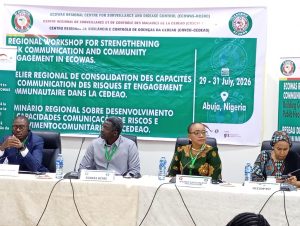
The meeting, which kicked off in Abuja, on Tuesday brought together health experts and officials from both countries, aimed to enhance collaboration, share information, and develop joint action plans to address public health emergencies.
The West African region has faced various public health challenges, including infectious disease outbreaks such as Ebola, Lassa fever, measles, and COVID-19 that transcend national borders, thus the importance of cross-border collaboration in disease surveillance and response.
The Republic of Niger and Sokoto State Nigeria share common borders, facilitating the movement of people, goods, and animals across these boundaries. The proximity of these countries increases the risk of infectious diseases spreading rapidly across borders, emphasizing the need for a coordinated and collaborative approach to disease surveillance.
Recall that an outbreak of an unknown disease suspected to be heavy metal poisoning in Sokoto state, reported on March 20, 2024, began in Isa Local Government Area (LGA).
According to Nigeria Centre for Disease Control and Prevention (NCDC), the symptoms include abdominal pain, abdominal distension, vomiting, fever, and breathing difficulty, affecting mainly children and young adults.
The suspected cases have been reported to other five LGAs; Illela, Sabon Birni, Tambuwal, Gwadabawa, and Dange Shuni.
Declaring the meeting open, the Minister of Health, Prof Ali Pate, noted that with a population of over 230 million people, Nigeria cannot fight infectious disease outbreaks that transcend national borders alone, particularly given the spill-over of huge populations from neighboring countries.
The Minister, who was represented by the Director, Port Health Services in the Ministry of Health, Dr. Akpan Nseobong, described the cross-border surveillance meeting as very important considering that since Nigeria and Niger Republic share borders, anything that happens to any of the two countries affects the other.
While commending the West African Health Organisation (WAHO) and the ECOWAS Regional Centre for Surveillance and Disease Control (RCSDC) and partners like the World Health Organisation (WHO), United States Centre for Disease Control (CDC), UNICEF and USAID for their support, the minister called for more collaboration with Nigeria to tackle the growing public health challenges.
“We will continue to appeal to our partners for more support because given the size of our country, once Nigeria is able to contain these diseases, the whole of West Africa and indeed Africa will be safe,” he said.
Addressing Newsmen at the event, Technical Advisor for Cross Border Surveillance, Dr. Aisha Usman, highlighted the mandate of WAHO, established in 1987, to support ECOWAS member states in harmonizing health policies and pulling resources together to strengthen public health systems.
“We are here to share experiences and also to identify some of the gaps the two countries can work on with a joint action plan that helps in containing some of the outbreaks that we had in the last one year and the one that is currently ongoing on the suspected heavy metal poisoning in the two countries.
“This is not the maiden edition, WAHO has been organizing other meetings among member States in the region depending on who shares borders with who.
“Currently we have an outbreak between Niger and Nigeria which is the suspected heavy metal poisoning and we are here in this meeting to know what is the current status from each country, what are the intervention put in place, and how can we improve on that, what support is required from WAHO to support the two countries,” Usman said.
Also speaking, Director of Public Health Services, Zamfara State Ministry of Health,
Dr. Yusuf Abubakar, noted the significance of the meeting, given the shared borders between Nigeria and Niger. “Whatever affects Zamfara or Sokoto States will inevitably impact Niger Republic.
“This meeting coordinates activities and information sharing, which is crucial for disease control and outbreak response,” he noted.
Abubakar expressed concerns over the rising incidence of heavy metal poisoning, emphasizing the need for coordinated action plans and interventions. “The meeting aims to develop a work plan for both countries to address this and other health issues, including diphtheria, meningitis, and cholera,” he said.
Oh his part, Director of Public Health, Sokoto Ministry of Health, Dr. Abdulganiyu Yusuf, emphasized the importance of environmental checks and preventive measures, such as ensuring safe water and soil quality.
“The heavy metal poisoning started in Nigeria, especially from Sokoto State where we first reported it about three months ago, precisely in March. Initially it was called an unknown disease but thanks to God, recently it has been diagnosed as multiple heavy metal poisons.
“So that is exactly what we are doing but we heard that Niger Republic has also started finding cases in their places so for that reason, the two countries are affected.
“There are preventive measures, this has to do with heavy metals poisoning, usually we have to look into our environment, the water we take, the soil we cultivate on and what have you. So there are things that have been put in place to ensure that you know, these things are curtailed.
“We have to look into water because water is one of the sources of these heavy metals poisoning, so the state government is trying through the ministry of Water Resources to chat way in how this water will either be trucked, there is what we call water trucking, to supply water or better still look for areas where boreholes or wells can be dugg so that water that doesn’t contain heavy metals can be used by the people.
“And then as well the soil. Some of the things that we have tested, like the food crops, traces of these metals have been found in these crops, so there is also an intention to consider how soil can probably be excavated in those areas,” Abdulganiyu said.
Reacting to the question on whether the disease is as a result of mining activities in the area, Abdulganiyu stated, “For Sokoto State, there has not been any pinpointed place where this mining activities take place but we wouldn’t know if such things take place in a hidden way that we have not been able to find but mining in Zamfara, yes, Sokoto, we have not reported any case of mining.”
Other speakers at the opening ceremony were the Director-General of WAHO, Dr. Aissi Melchior Athanase, who was represented by the Executive Director of ECOWAS RCSDC, Dr. Virgil Lokossou; representative of UNICEF, Dr. David Dauda; representative of WHO, Dr. Beatrice Muraguri and Dr Elh Ibrahim Tassiou from Niger Republic.