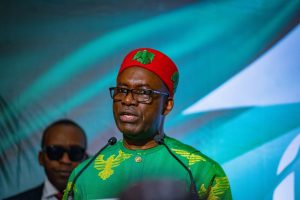
Lawmakers at the Senate
Senate Committee on Public Accounts has directed the Federal Ministry of Finance to appear alongside the Nigerian National Petroleum Company Limited (NNPCL) and the Nigerian Upstream Petroleum Regulatory Commission (NUPRC) to address outstanding queries in the 2021–2023 Oil and Gas Sector Audit Reports of the Nigeria Extractive Industries Transparency Initiative (NEITI).
The directive followed the appearance of the Permanent Secretary, Federal Ministry of Finance, Raymond Omachi, before the committee on Thursday August 13.
Omachi told the committee that the ministry had been unable to provide satisfactory answers to some of the queries because it had not received the necessary records from agencies involved in the transactions, particularly the NNPCL and NUPRC.
One of the issues raised by NEITI was a $3 billion pre-export financing loan obtained in 2012 to settle subsidy payments. The audit report questioned how the loan was recovered from monthly Federation revenue under the Pre-Export Financing and Project Eagle agreements.
NEITI also queried the handling of $722.6 million in dividends and interest paid by Nigeria LNG Limited (NLNG) to the NNPC in 2021.
The agency said the funds, earned on behalf of the Federation, were neither remitted to the Federation nor properly accounted for.
The audit report further questioned the expenditure of about N200 billion on Nigeria’s refineries, noting that none of the refineries was operational in 2021.
It also raised questions over $221.283 million in overhead costs incurred by the National Petroleum Investment Management Services (NAPIMS) in 2021.
Explaining the ministry’s position, Omachi said it was not directly involved in all the transactions under review and depended on the relevant agencies to provide records needed to reconcile the accounts.
“We don’t have direct involvement in all the issues raised and required provision of financial records from the affected agencies, particularly NNPCL, NUPRC etc, is not there,” he said.
Omachi disclosed that the ministry had engaged Arthur Andersen LLP to conduct a forensic audit of the transactions and assist in reconciling the disputed figures.
He said, “In resolving the financial issues, we have engaged a reputable external audit firm, Arthur Andersen LLP to carry out forensic audit on all the transactions for required reconciliation.”
The explanation, however, did not satisfy the committee, which questioned the ministry on when the forensic audit would be completed, particularly as previous extensions had already been granted.
The committee, chaired by Senator Ibrahim Dankwambo, subsequently directed the Finance Ministry to ensure that the affected agencies appear before it to provide explanations on the outstanding queries.
Omachi appealed to the committee to compel the agencies to attend, saying the ministry was ready to appear alongside the NNPCL and NUPRC.
He said the ministry had faced difficulties getting the agencies to provide the necessary information and sit down with it to resolve the issues.
The committee chairman directed Omachi to review the ministry’s internal report and arrange a joint meeting involving the Finance Ministry, NNPCL, NUPRC and any other relevant agency.
Dankwambo said the issues were of international interest because they involved the management and accountability of Nigeria’s extractive industry revenues.
He urged the agencies to provide the necessary records and resolve the outstanding discrepancies in the interest of the country.
The committee is expected to reconvene the affected agencies with the Finance Ministry to obtain direct explanations and determine responsibility for the outstanding financial issues.
The failure to account for large sums of money in the petroleum sector undermines public confidence in government institutions responsible for managing Nigeria’s most critical revenue source. International investors and development partners may view the lack of transparency and accountability as a risk factor, potentially reducing foreign direct investment (FDI) inflows into Nigeria’s oil and gas sector and broader economy.
Analysts also express concern that the dispute impact on revenue mobilization and budgeting because petroleum revenues constitute a substantial portion of Nigeria’s national budget and foreign exchange earnings. Unreconciled funds and missing records can lead to inaccurate revenue projections, affecting government spending plans.
This uncertainty may constrain the government’s ability to fund essential public services, infrastructure projects, and social programs, thereby slowing economic growth and development.
Addressing these issues through coordinated audits, institutional reforms, and enhanced transparency is critical to safeguarding Nigeria’s economic future and maximizing the benefits of its natural resources.