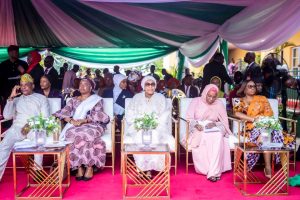
Kaduna State Governor Uba Sani has reaffirmed that President Bola Ahmed Tinubu’s Renewed Hope Agenda places agriculture at the centre of Nigeria’s economic transformation, driving inclusive growth and national prosperity.
Speaking while declaring open the 47th National Council on Agriculture and Food Security meeting at the Umaru Musa Yarádua Conference Centre, Kaduna, Governor Sani said the Federal Government’s policies on mechanization, value-chain integration, input accessibility and rural infrastructure are rekindling optimism and laying a firm foundation for sustainable development.
The governor noted that Kaduna State fully aligns with the national vision for food security, describing agriculture as the cornerstone of his administration’s rural transformation and inclusive development agenda.
“We have pursued deliberate, evidence-based interventions that empower both smallholder and large-scale farmers, expand access to inputs and markets, and promote agribusiness development,” he said.
Governor Sani described Kaduna as Nigeria’s foremost agricultural hub, blessed with vast arable land, dynamic farmers and strong market systems.
“We are the number one producer of ginger in Nigeria, the leading producer of maize and grapes, and the second-largest producer of soybeans. Agriculture contributes nearly 43 percent of Kaduna’s GDP and employs about 60 percent of our workforce,” he said.
He disclosed that his administration had increased the state’s agriculture budget from ₦1.48 billion in 2023 to ₦74.02 billion in 2025, a rise of 4,871 percent—adding that the allocation now accounts for over 14 percent of the total state budget, surpassing the Malabo Declaration target.
“We have implemented the largest fertilizer distribution in the state’s history, delivering over 900 trucks of fertilizer to smallholder farmers across the 23 local government areas in the past two years,” he added.
The governor also highlighted the implementation of Wet and Dry Season Agricultural Empowerment Programmes, which have distributed improved seeds, irrigation equipment, and mechanization tools to thousands of farmers, alongside support for livestock production through feed, vaccines and fodder infrastructure.
To cushion risks in the sector, Sani said over 100,000 smallholder farmers are being enrolled into a crop risk insurance scheme to protect them from losses caused by pests, diseases and climate change impacts.
He explained that fertilizer was also being provided to commercial farmers at subsidized rates to reduce production costs, boost job creation, and stabilize prices in the open market.
In his address, the Minister of Agriculture and Food Security, Senator Abubakar Kyari, described agriculture as the largest employer of labour in Nigeria and a key driver of the nation’s resilience.
“Agriculture is the measure of our nation’s resilience and the foundation of our collective renewal. It represents the work of our hands, a driver of industry, a pillar of stability and the promise of our future,” Kyari said.
Quoting President Tinubu, the minister reiterated that “our farmers must transition from hoes and cutlasses to tractors and harvesters. Food sufficiency is the first currency of national stability.”
He noted that government’s commitment to food sovereignty is anchored on the Nigeria Vision 2050, the National Development Plan (2021–2025), and the National Agricultural Technology and Innovation Policy, among others.
“Food sovereignty speaks to our control over what we grow, how we grow it and how we consume it, while food security ensures every household has access to safe, affordable and nutritious food,” the minister added.