Kaduna State Governor Uba Sani has commended President Bola Ahmed Tinubu for selecting Tudun Biri village as the first beneficiary of the Federal Government’s Resettlement Scheme for Persons Impacted by Conflicts, following the accidental airstrike that claimed innocent lives in December 2023.
The governor, who spoke on Friday at the commissioning of key projects in the community, said the President’s directive transformed a tragic incident into an integrated development model anchored on resettlement, infrastructure, and livelihood restoration.
The projects commissioned at Tudun Biri include newly constructed houses, a six-kilometre asphalt road, a Primary Healthcare Centre, a Skills Acquisition Centre, and other supporting social infrastructure.
According to Uba Sani, the initiative demonstrates that lasting peace is achieved not only through security measures but also through development, inclusion, and economic opportunity.
“This initiative moved beyond temporary relief to comprehensive reconstruction, delivering modern homes supported by essential social infrastructure designed for safe and sustainable living,” the governor said.
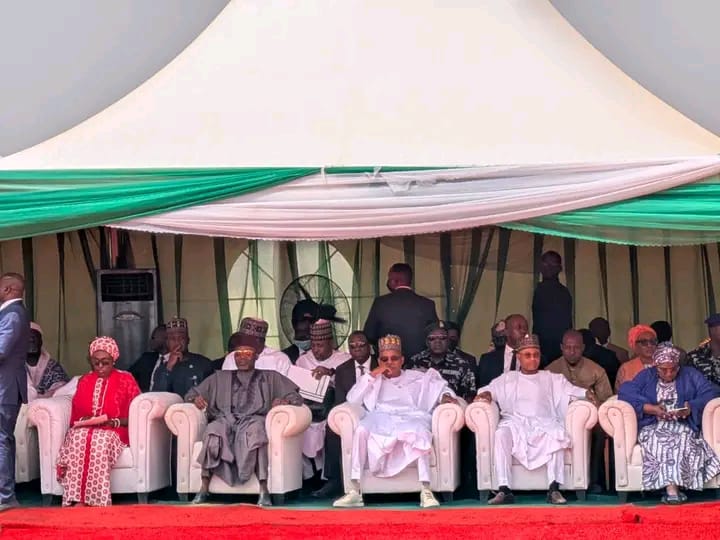
He explained that the Kaduna State Government played a central role in the reconstruction process from the immediate aftermath of the tragedy to the commissioning of completed projects.
Uba Sani noted that portions of farmland were converted for residential and community infrastructure development to ensure orderly housing and public facilities, adding that affected farmers were fully consulted and supported.
“Farmers whose lands were impacted were assisted through livelihood support, priority access to agricultural inputs, empowerment programmes, skills acquisition, and alternative income opportunities where necessary,” he said.
The governor said that in the immediate aftermath of the incident, the state government coordinated emergency medical care, provided psychosocial support, and worked closely with community leaders to ensure effective relief distribution.
“As recovery progressed, our focus expanded to healthcare, education, livelihoods, and infrastructure, guided by our firm policy that Kaduna State will not tolerate the creation of internally displaced persons camps,” he said.
According to him, the state’s approach prioritises resettlement within communities, preservation of social bonds, and the restoration of economic life.
Uba Sani disclosed that a 25-bed Primary Healthcare Centre equipped to provide comprehensive services—including maternal care, minor surgeries, and ophthalmological treatment—has been constructed and fully equipped in Tudun Biri.
He added that infrastructural development was critical to the community’s recovery, noting that a six-kilometre asphalt road linking Tudun Biri to the Kaduna International Airport corridor had been completed.
The governor said Tudun Biri residents were prioritised in the state’s social intervention programmes, with the distribution of fertiliser, rice, maize, and other agricultural inputs, alongside sustained psychosocial and medical support provided through the Kaduna State Emergency Management Agency.
He further disclosed that a Skills Acquisition Centre was established to equip youths with vocational and entrepreneurial skills to promote employment and self-reliance.
“In education, a new primary school has also been constructed with the support of the Nigerian Army and development partners to ensure uninterrupted learning for our children,” he said.
The governor commended Vice President Kashim Shettima for his leadership and oversight of the initiative, describing his role as instrumental to its success.
“As Chairman of the committee that refined and guided the implementation plan, the Vice President ensured that commitments were translated into measurable outcomes,” Uba Sani said.
He noted that Shettima’s commitment to conflict-affected communities was evident from his experience as former governor of Borno State.
“We join the people of Tudun Biri in thanking him for his steadfast dedication,” the governor added.
Uba Sani also expressed appreciation to the Director-General of the National Emergency Management Agency (NEMA), Mrs Zubaida Umar, and her team for ensuring effective coordination, transparent deployment of resources, and diligent monitoring of the project.
Earlier in his remarks, Vice President Shettima said the commissioning of the Tudun Biri Resettlement Scheme reaffirmed the Federal Government’s belief that compassion is a moral strength of the state and that no citizen should be abandoned in times of adversity.
He described the scheme as a vehicle of hope for families whose lives were disrupted, assuring them that the Nigerian state stands with them.
Shettima explained that the rehabilitation initiative is part of a broader Federal Government programme aimed at delivering durable recovery and resettlement solutions across several states.
“Similar projects are ongoing in Kaduna, Kebbi, Sokoto, Zamfara, Niger, Katsina, and Benue states,” he said.
According to him, the projects reflect a coordinated national response to internal displacement, focused on community resilience and the restoration of dignity to Nigerians affected by conflict and insecurity.
The Vice President commended Governor Uba Sani for his inclusive approach to governance and constructive partnership with the Federal Government.
“The success of initiatives such as this depends on collaboration, trust, and shared ownership between the Federal Government, state governments, host communities, and development partners,” he said.