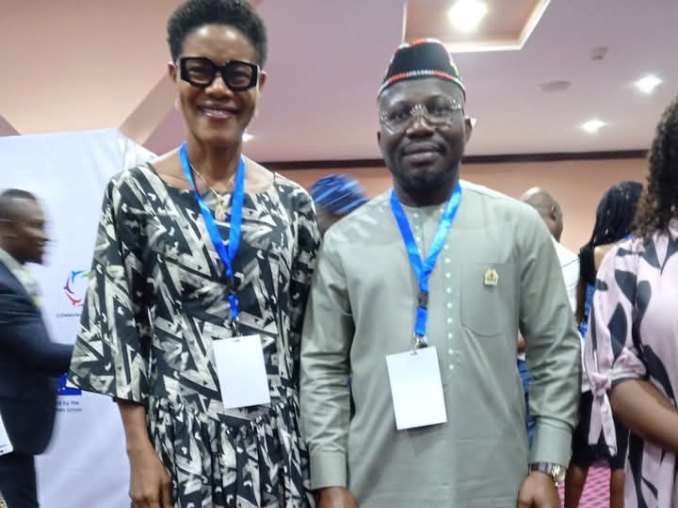
Hon KufreAbasi Edidem, Deputy Speaker, Akwa Ibom State House of Assembly (r) and another participant at the conference
By ANIEFIOK UDONQUAK, Uyo –
A regional conference organised by Global Rights in partnership with the community of Practice on Civil Space strengthening for the South South zone and held in Uyo, the Akwa Ibom.State capital has solicited an improvement on the operational environment for Civil Society Organisations (CSOs) in Nigeria.
The conference which had as its theme “Scaling Policy to Action – Strengthening the Regulatory Environment for Sustainable CSO Operations at the Subnational Level,” brought together civil society leaders, regulators, and development actors to reflect on policy recommendations from the 2024 regional convening and explored how these have been scaled into action.
Experts believe Civil Society Organizations (CSOs) play a critical ole in promoting democracy, fostering accountability, and empowering communities, yet across Nigeria—especially at the subnational level—many CSOs face operational and regulatory constraints, including duplicative registration requirements and burdensome financial obligations imposed by multiple state agencies.
Ken Henshaw, co-chair, community of practice and head, ‘We the people, ‘ lamented that the civil space in the country was getting restricted adding that it has become for the citizens to participate actively in democratic process in the country.
He said strengthening the civic space will broaden the participation of the people in exercising their rights adding that the freedom to speak out is limited while the existing atmosphere was repressive .
According to him, many Nigerians have been killed during protests while exercising their rights while both journalists and members of the civil society have been arrested and detained in the country while exercising their democratic rights.
He however expressed the hope that “with civil society organisations learning to work closely together with the authorities the suspicion was gradually disappearing
“That gap that existed between civil society and government officials as represented by the number of government agencies and officials in out midst here today demonstrates that the suspicion is gradually disappearing and we are learning to work more closely together.
“It is important that in the past, the relationship between the civil society and government has essentially been characterised by suspicion and sometimes acrimony, where the government often sees civil society as critics, unnecessary interlopers. And civil society see government officials as enemies which should be watched and checked.
“But through this project, that narrative is gradually changing, we are gradually being seen as partners in progress, partners who want to see how our country can go forward and to see an improved civil society environment and improved indicators for ourselves..
“It is my honest and sincere expectation that at the end of this conference, we would have been able to bridge that gap further when we will see further collaboration , closer partnership and closer synergy.
“It is also important to note that true this conference, and other activities within this project by the community of practice, we have come to the realisation that that there is no us and them, , there is no there and us, there is just us, citizens of the federal republic of Nigeria who want exactly the same thing, to work together in peace, harmony and in synergy to see our country move forward.”
In her contributions, the Executive Director, Global Rights, Abiodun Baiyewu noted that “great progress has been made in the past one year to deepen the consensus on the contributions of Civil Society Organisations to the development of the country adding “let us build Nigeria where peace and justice reign.”
In one of the panel discussions chaired by Tijah Bolton Akpan, executive director of Project Alert, he decried the disparity in the operating environment between the North and the Southern part of the country , a development which he attributed to the different focus of CSOs between the the two regions of the country.
According to him, a whole new level of restriction exist between the North and South adding that while the focus of the CSOs in the North may be on humanitarian services, those in the South were on governance and human rights.
There was also a presentation of an award to KufreAbasi Edidem, the deputy speaker of the Akwa Ibom state house of assembly for his contributions to the strengthening of the civil space in the state.
Edidem who presented a paper at the conference highlighted the contributions of the civil society in the country which he said included the promotion of the rule of law , social justice and furthering political participation among the citizenry.
A presentation of the 2025 CSO state ranking dashboard was equally presented.