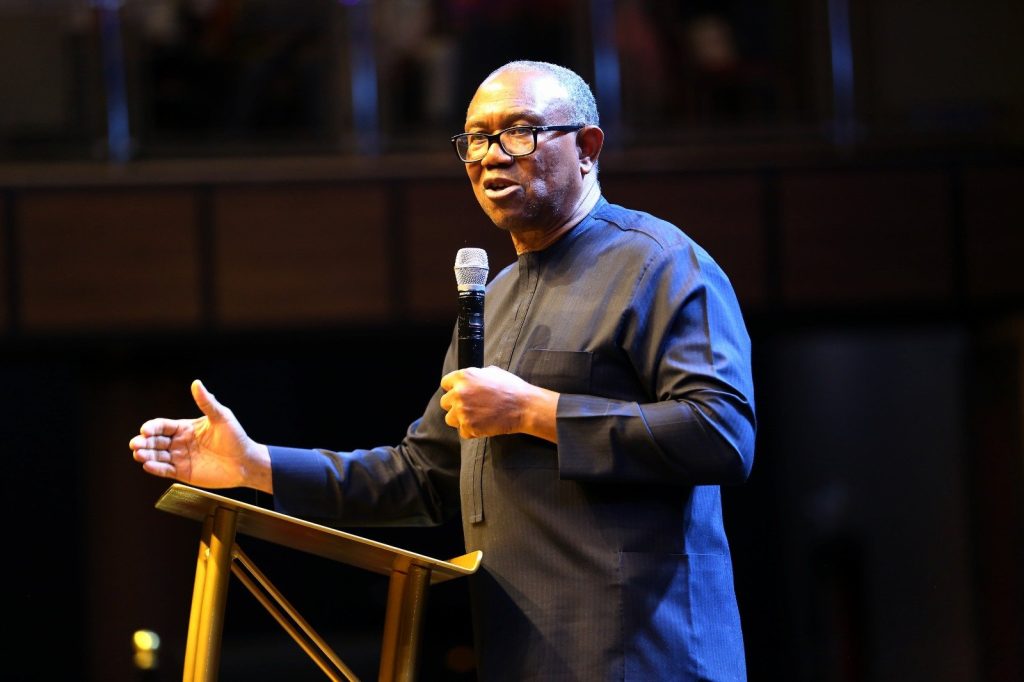
2027 NDC Presidential candidate, Peter Obi
Nigeria Democratic Congress (NDC) presidential candidate, Peter Obi, has used the occasion of Father’s Day to reflect on Nigeria’s journey over the decades, expressing concern over what he described as the country’s declining fortunes while urging citizens to take responsibility for building a better future.
In a message shared on his X handle, Obi said his reflections after attending church service led him to ponder the state of the nation and the role Nigerians must play in reversing its challenges.
“Today is Father’s Day. After attending church service and in my routine reflection, I find myself once again asking a difficult question: Are we cursed, or are we the cause?” he wrote.
The former Anambra State governor recalled growing up in a Nigeria where people related freely across ethnic, religious and regional lines, noting that national unity was stronger during his formative years.
According to him, students in primary school, secondary school and university interacted without the divisions that have increasingly shaped public discourse in recent years.
“I grew up in a Nigeria that was more united and peaceful. In my primary, secondary school and university days, students related freely without divisions of religion, ethnicity, or region. We simply saw ourselves as Nigerians,” Obi stated.
He also reminisced about an era when business relationships were built largely on trust and competence rather than ethnic or religious considerations. He noted that the Nigerian passport commanded greater respect internationally and that citizens enjoyed easier mobility across borders.
Obi further recalled travelling across different parts of the country without fear, describing a period when security conditions were considerably better and public confidence in national institutions was stronger.
“I lived in Nigeria, where I travelled across the country—from Onitsha to Lagos, Maiduguri, and Calabar—without fear. Roads connected people, and life was more secure,” he said.
The former presidential candidate added that beyond security, Nigeria once enjoyed greater public trust in governance, more credible elections, stronger educational institutions, a more functional healthcare system and relatively better infrastructure.
However, he lamented that many of those gains have eroded over time, leaving citizens confronted with insecurity, economic hardship and declining opportunities.
“Today, as a father reflecting on Nigeria, I am pained that much of this has changed. Insecurity has grown, national unity has weakened, and many citizens no longer feel safe. Opportunities have also diminished for the younger generation compared to what we once had,” he wrote.
Obi also expressed concern over what he sees as Nigeria’s diminishing influence on the global stage. He cited the recent G7 meeting, where countries such as Egypt and Kenya received invitations while Nigeria was absent.
“It is also worrisome that Nigeria’s influence in global affairs appears reduced, as seen in recent international gatherings such as the just-concluded G7 meeting, where African countries like Egypt and Kenya were invited, while Nigeria was absent. Whether symbolic or not, it reflects a decline in standing we cannot ignore,” he stated.
Despite his concerns, Obi said fathers and citizens alike must move beyond lamentation and work towards creating a more secure, prosperous and united nation for future generations.
“As fathers, we must not only lament. We must not bequeath this reality to our children. We owe them a better Nigeria built on security, opportunity, fairness, and national pride,” he said.
He stressed that active participation in the democratic process remains essential to achieving meaningful change, urging Nigerians to obtain their Permanent Voter Cards (PVCs), vote responsibly and safeguard the integrity of the electoral process.
“A key part of achieving this is active civic participation. We must obtain our Permanent Voter Cards (PVCs), vote responsibly, and remain committed to protecting the integrity of our votes. Change will not come from complaints alone but from citizens who choose and defend accountable leadership,” Obi added.
He concluded on a hopeful note, expressing confidence that collective commitment and responsible citizenship can help transform the country.
“With responsibility, unity, and determination, we can together build the new Nigeria that is POssible.”